Taxi theory exam practice: 20 free questions
These 20 practice questions come from 12 topics of the exam material for the taxi theory exam (TVT). Choose your answer; you see straight away if it is right, with the explanation. In the real exam you get 40 questions in 60 minutes and you pass with 32 correct.
These are practice questions from TaxiTheorieHub, not CBR exam questions.
Question 1 of 20
A driver has a restricted driver card. Every school day he drives the same children. He does this under a written agreement with fixed fares. What must be present in the car?
Read this question in Dutch
Een chauffeur heeft een beperkte chauffeurskaart. Hij rijdt elke schooldag dezelfde kinderen. Dat doet hij volgens een schriftelijke overeenkomst met vaste tarieven. Wat moet er in de auto aanwezig zijn?
- Een kopie van zijn chauffeursdiploma en zijn VOG
- Administratie die laat zien dat het dit soort vervoer is
- Een taxi-informatiekaart die zichtbaar is voor passagiers
With a restricted card he may only drive this kind of fixed trips. That is why the part of the records that shows it really is this type of transport must be in the car.
Bp 2000 art. 81 lid 4 en 6Question 2 of 20
A taxi driver knows that his colleague has drunk too much alcohol. He still lets this colleague drive his taxi. Does the driver himself break the Road Traffic Act 1994?
Read this question in Dutch
Een taxichauffeur weet dat zijn collega te veel alcohol heeft gedronken. Toch laat hij deze collega zijn taxi besturen. Overtreedt de chauffeur zelf de Wegenverkeerswet 1994?
- Ja
- Nee
It is forbidden to let a motor vehicle be driven by someone who is known to be under the influence. So the driver himself is also in breach.
WVW 1994 art. 8 lid 6Question 3 of 20
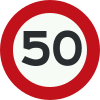
Outside the built-up area, where 80 km/h normally applies, there is this sign. Which maximum speed must the taxi driver keep here?
Read this question in Dutch
Buiten de bebouwde kom, waar normaal 80 km/u geldt, staat dit bord. Welke maximumsnelheid moet de taxichauffeur hier aanhouden?
- 50 km/u: de waarde op het bord gaat boven de algemene limiet
- Gewoon 80 km/u, want dat is de standaardlimiet buiten de bebouwde kom
- Hij mag zelf kiezen tussen 50 en 80 km/u
A traffic sign with a specific maximum speed takes precedence over the general limit that normally applies on that type of road; the taxi driver keeps to the value on the sign, here 50 km/h.
RVV 1990 art. 20-21; bord A1/H1Question 4 of 20
What is correct about the Sociaal Fonds Mobiliteit (SFM)? Choose 2 answers.
Read this question in Dutch
Wat is juist over het Sociaal Fonds Mobiliteit (SFM)? Kies 2 antwoorden.
- Het SFM is een onderdeel van de ILT
- Het SFM is opgericht door de cao-partijen in de taxibranche
- Het SFM controleert of de cao Zorgvervoer en Taxi wordt nageleefd
- Het SFM wordt volledig door de overheid betaald
The SFM is a foundation of the collective agreement parties in the taxi sector: KNV Zorgvervoer en Taxi, FNV and CNV. The SFM checks compliance with the collective agreement and is funded by contributions from employers and employees.
Cao Zorgvervoer en Taxi art. 8.3 en 8.5Question 5 of 20
Who can make TX-Keur a requirement for a taxi company?
Read this question in Dutch
Wie kan het TX-Keur als eis stellen aan een taxibedrijf?
- De politie, bij elke verkeerscontrole van een taxi
- De RDW, bij de jaarlijkse APK-keuring van de taxi
- Bijvoorbeeld zorgverzekeraars en gemeenten
The quality mark can be a mandatory requirement of, for example, health insurers, municipalities, authorities and operators of private taxi ranks such as Schiphol.
Kiwa TX-KeurQuestion 6 of 20
Passengers shout and push against the driver's seat back. This distracts him. What does he do?
Read this question in Dutch
Passagiers roepen en duwen tegen de rugleuning van de chauffeur. Hij raakt hierdoor afgeleid. Wat doet hij?
- Hij stopt op een veilige plek en vraagt om rust.
- Hij zet de muziek harder om het geluid te overstemmen.
- Hij draait zich om en praat de passagiers toe.
Distraction is a risk. The driver deals with it while the car is standing still.
CBR Exameneisen TVT, toetsterm 4.1Question 7 of 20
On a provincial road a taxi driver places a warning triangle behind his stationary taxi. At about how many metres from the taxi must the triangle stand?
Read this question in Dutch
Een taxichauffeur zet op een provinciale weg een gevarendriehoek achter zijn stilstaande taxi. Op ongeveer hoeveel meter van de taxi moet de driehoek staan?
The warning triangle stands clearly visible at about 30 metres from the vehicle, on the side of the traffic for which it is a danger.
RVV 1990 art. 58Question 8 of 20
There is a passenger in the taxi. The dispatch centre calls via the hands-free system about the next trip. The dispatcher starts talking about the name, address and illness of the next passenger. What does the driver do?
Read this question in Dutch
Er zit een passagier in de taxi. Via de handsfree belt de centrale over de volgende rit. De centrale begint over de naam, het adres en de ziekte van de volgende passagier. Wat doet de chauffeur?
- Hij vraagt de centrale de gegevens later of via de app te sturen.
- Hij laat de centrale doorpraten, want het gaat om werk.
- Hij herhaalt de gegevens hardop, zodat hij ze onthoudt.
The passenger in the taxi can hear everything. The driver handles personal data of other passengers carefully. So he does not let it be discussed out loud.
CBR exameneisen TVT, toetsterm 6.2; KNV Algemene Voorwaarden art. 7 lid 6Question 9 of 20
A taxi driver is waiting at the taxi rank. A passenger asks for a short ride of two streets. The driver would rather wait for a longer ride. May he refuse this ride?
Read this question in Dutch
Een taxichauffeur wacht op de taxistandplaats. Een passagier vraagt om een korte rit van twee straten. De chauffeur wacht liever op een langere rit. Mag hij deze rit weigeren?
- Ja
- Nee
At the taxi rank the carrier is obliged to accept the passenger's request. A short ride is not a reason to refuse.
KNV Algemene Voorwaarden art. 3 lid 2Question 10 of 20
Yesterday a passenger threatened the driver. There is no danger now. The driver wants to report it to the police. Which number does he call?
Read this question in Dutch
Een passagier heeft de chauffeur gisteren bedreigd. Er is nu geen gevaar meer. De chauffeur wil aangifte doen. Welk nummer belt hij?
- 112
- 0900-8844
- 144
112 is for emergencies, such as danger to life or a crime happening at that moment. To report something to the police without urgency, the driver calls 0900-8844.
Rijksoverheid, wanneer 112 bellenQuestion 11 of 20
The Geschillencommissie Zorgvervoer en Taxi consists of three people. Who sits on this committee? Choose 2 answers.
Read this question in Dutch
De Geschillencommissie Zorgvervoer en Taxi bestaat uit drie personen. Wie zitten in deze commissie? Kies 2 antwoorden.
- Een inspecteur van de ILT
- Een onafhankelijke voorzitter
- Een vertegenwoordiger namens de reizigers
- Een ambtenaar van de gemeente
The committee has three members: an independent chairperson, a representative on behalf of clients and passengers and a representative on behalf of carriers. The ILT and the municipality are not on it.
Reglement Geschillencommissie Zorgvervoer en Taxi art. 2Question 12 of 20
Which A-road connects Amsterdam, Leiden and The Hague?
Read this question in Dutch
Welke A-weg verbindt Amsterdam, Leiden en Den Haag?
- A4
- A13
- A12
The A4 runs from Amsterdam via Schiphol and Leiden to The Hague. The A13 and the A12 start at The Hague and do not reach Amsterdam or Leiden.
Wikipedia, Lijst van Nederlandse autosnelwegenQuestion 13 of 20
A passenger books a taxi by phone in advance. How does he get the information about tariffs and complaints?
Read this question in Dutch
Een passagier bestelt vooraf een taxi per telefoon. Hoe krijgt hij de informatie over tarieven en klachten?
- Op de taxi-informatiekaart in de taxi, dus niet digitaal of online
- Dan hoeft hij die informatie niet te krijgen, want de rit is al besteld
- Digitaal, bijvoorbeeld via een link per mail of telefoon
For a pre-booked trip the card is not compulsory. The passenger must still receive the information on tariffs and complaints online.
ILT taxi-informatiekaart; OndernemerspleinQuestion 14 of 20
An ILT inspector sees that a driver has not kept to the working and rest times. What can he do?
Read this question in Dutch
Een ILT-inspecteur ziet dat een chauffeur zich niet aan de arbeids- en rusttijden heeft gehouden. Wat kan hij doen?
- Het rijbewijs van de chauffeur voor een jaar innemen
- De chauffeur bevelen een tijd niet verder te werken
- De taxi in beslag nemen en verkopen
The ILT can give a fine and an order to stop. Then the driver may not continue working for a certain time.
ILT: bevel tot stakenQuestion 15 of 20
A tram is standing at a stop. Passengers are getting off on the side where a taxi driver wants to drive past the tram. Must the taxi driver give them the opportunity to get off?
Read this question in Dutch
Een tram staat stil bij een halte. Passagiers stappen uit aan de kant waar een taxichauffeur de tram wil voorbijrijden. Moet de taxichauffeur hun de gelegenheid geven om uit te stappen?
- Ja
- Nee
Anyone who wants to pass a stationary tram or bus on the side where passengers get on and off must give them the opportunity to do so.
RVV 1990 art. 52Question 16 of 20
A full collective agreement applies. A planner makes a driver's roster. What statutory limit on working time must he keep to?
Read this question in Dutch
Er geldt een volledige collectieve regeling. Een planner maakt het rooster van een chauffeur. Aan welke wettelijke grens voor de arbeidstijd moet hij zich houden?
- Gemiddeld ten hoogste 48 uur per week in elke periode van 26 weken
- Ten hoogste 12 uur per dienst en 60 uur per week
- Gemiddeld ten hoogste 40 uur per week in elke periode van 52 weken
The employer organises the work so that the average in every period of 26 weeks is at most 48 hours per week. The 12 hours per shift and 60 hours per week belong to the rule without a collective agreement.
ATB-V art. 2.5:7 lid 6Question 17 of 20
A taxi driver drives with a calm driving style. What are the consequences? Choose 2 answers.
Read this question in Dutch
Een taxichauffeur rijdt met een kalme rijstijl. Welke gevolgen heeft dat? Kies 2 antwoorden.
- Hij verbruikt meer brandstof.
- Hij hoeft minder te remmen en op te trekken.
- Hij verliest veel tijd op korte ritten.
- Hij heeft minder stress.
With a calm driving style the driver has to brake and accelerate less. He drives more economically and has less stress. On short rides driving fast saves almost no time.
Het Nieuwe Rijden, rijtipsQuestion 18 of 20
An accident has happened on the motorway and traffic is being diverted. Where does the driver see this on the road?
Read this question in Dutch
Op de snelweg is een ongeval gebeurd en het verkeer wordt omgeleid. Waar ziet de chauffeur dit op de weg?
- Op de hectometerpaaltjes langs de berm
- Op de witte strepen van de rijbaan
- Op dynamische routeinformatiepanelen (DRIP's)
Rijkswaterstaat shows diversions on signs above and beside the road, the DRIPs. Hectometre markers only show the position.
Rijkswaterstaat: incidentmanagementQuestion 19 of 20
At the destination the passenger has fallen asleep. He said earlier that he took medication. What does the driver do?
Read this question in Dutch
Bij de bestemming is de passagier in slaap gevallen. Hij heeft eerder gezegd dat hij medicijnen heeft genomen. Wat doet de chauffeur?
- Hij spreekt de passagier aan tot die wakker is en helpt bij uitstappen.
- Hij laat de passagier slapen en rijdt door naar de standplaats om te wachten.
- Hij schudt de passagier hard heen en weer tot hij wakker wordt.
Take medication use into account. Wake the passenger gently and help him get out safely.
Eindterm 7.3 (afbakening)Question 20 of 20
A driver knows the city well. He knows that his own route is faster today than the navigation route, because of roadworks. The passenger has not asked for anything. Which route does he take?
Read this question in Dutch
Een chauffeur kent de stad goed. Hij weet dat zijn eigen route vandaag sneller is dan de route van de navigatie, door werkzaamheden. De passagier heeft niets gevraagd. Welke route rijdt hij?
- De route van de navigatie, ook al duurt die vandaag langer
- Zijn eigen route, want die is sneller voor de passagier
- De route die voor hemzelf het meeste oplevert
The driver takes the most favourable route for the passenger, for example the fastest. He does not have to follow the navigation if he knows a better route.
KNV Algemene Voorwaarden art. 7 lid 2; CBR exameneisen TVT, toetsterm 11.3Your score
In the exam you need 32 of the 40 questions correct, which is 80%.
Want to practise more?
The app has more than 1100 questions and full practice exams of 40 questions that cover all 30 toetstermen (test terms).

Keep practising in the app
In TaxiTheorieHub you practise with more than 1100 questions in the question types of the exam, take full practice exams of 40 questions and read the explanation for every question. In 12 languages, with the Dutch of the exam one tap away.
Download on the App Store