
Voorsorteren (getting in lane): what is it and how do you do it?
Voorsorteren means getting in lane: choosing, in good time before you turn, the place on the road that belongs to your direction. If you want to turn right, you move as far to the right as possible. If you want to turn left, you move as close to the middle of the road as possible.
Voorsorteren meaning: this is how you do it
| You want to | Place on the road |
|---|---|
| Turn right | As far to the right as possible |
| Turn left, road with traffic in two directions | As close as possible to the centre line (the middle of the road) |
| Turn left, carriageway for one direction | As far to the left as possible |
Before you turn, you indicate with your indicator (Article 17, paragraph 2). Moving to the left or right is itself also a sideways movement for which you indicate (Article 55). If you change lanes while doing so, that is a special manoeuvre and you let other traffic go first (Article 54).
Voorsorteerstroken: arrows on the road surface
At bigger junctions there are direction lanes (voorsorteerstroken, also called voorsorteervakken) with arrows. There the choice is no longer free. Drivers who follow the carriageway are obliged to follow, at the junction, the direction that their direction lane shows (Article 78). So if you are in the wrong lane, you drive in the direction of the arrow and turn round further on. You may not cross a solid line between the lanes (Article 76).
Voorsorteren sign: L4
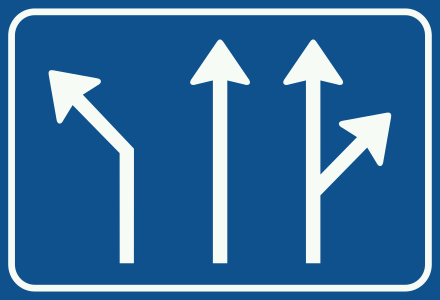
The sign for voorsorteren is sign L4, a blue sign with white arrows. It belongs to the information signs and shows in advance that you have to choose. There is more about this sign on the page of sign L4.
May you get in lane on a cycle lane?
That depends on the line.
- Cycle lane (fietsstrook) with a solid line: no. Only cyclists and drivers of a disability vehicle (gehandicaptenvoertuig) may use it (Article 10, paragraph 2).
- Cycle lane with a broken line: the ban from Article 10 does not apply there. So getting in lane on the cycle lane is not forbidden there. You may not stop on it (Article 23) and, when you turn, you let cyclists go first who are next to you or close behind you on the right (Article 18).
If a cycle lane lies in a direction lane, the cycle lane is part of that direction lane (Article 78). Read on in cycle lane: what is and is not allowed and turning right and the blind spot.
What changes once you have got in lane?
- You are overtaken on the right. Drivers who have got in lane on the left and have indicated that they want to turn left are overtaken on the right (Article 11, paragraph 2).
- You do not get priority. Getting in lane changes nothing about the order. Anyone who turns lets traffic go first that continues straight on along the same road (Article 18). See turning and priority.
Voorsorteren in special places
- One-way road. For a left turn you drive as far to the left as possible, because there should be no oncoming traffic on the carriageway. See one-way road.
- Roundabout. Just before or on a roundabout, drivers of a motor vehicle and moped riders who follow the carriageway may also drive elsewhere than on the right-hand side of the carriageway (Article 47).
- Motorway (autosnelweg). Lorries and combinations of vehicles that are together longer than 7 metres may, on a carriageway with three or more lanes, only use the two right-hand lanes, except when they have to get in lane (Article 43, paragraph 4).
The word voorsorteren is on the CBR's word list. You can practise at special manoeuvres practice.
Frequently asked questions
What does voorsorteren mean?
Taking, in good time before you turn, the place on the road that belongs to your direction: as far to the right as possible for a right turn, by the centre line of the road for a left turn (Article 17 of the RVV 1990).
Is voorsorteren compulsory?
Article 17 says that drivers may get in lane. On a direction lane with arrows you are obliged to follow the direction shown (Article 78).
May you get in lane on a cycle lane?
Not on a cycle lane with a solid line. With a broken line that ban does not apply, but stopping on the cycle lane is never allowed and cyclists next to you go first when you turn.
Which sign belongs to voorsorteren?
Sign L4: getting in lane (voorsorteren).
Do you get priority once you have got in lane?
No. When turning you still let traffic go first that continues straight on along the same road (Article 18).
Want to practise? Try the free questions on special manoeuvres, with an explanation for every answer.
Practise this with 2,606 questions and 19 animations
Rijtheorie Hub practises exactly like the CBR exam: 50 questions, 30 minutes, pass with 44. Free to try, in 12 languages.
Download free Get it on Google Play