
One-way street in the Netherlands: signs, rules and the difference from a mandatory direction
A one-way street (eenrichtingsweg) is a road where vehicles may drive in one direction only. You recognise it by the blue signs C3 and C4 with a white arrow. On the side where you may not enter, you see sign C2: round and red with a white bar.
What is a one-way street?
With one-way traffic (eenrichtingsverkeer), all traffic with a vehicle goes the same way. So in principle you have no oncoming traffic on the carriageway (rijbaan). The road is closed from one side: under Article 1 of the RVV 1990, a closure (geslotenverklaring) is a ban on driving or going into the road and on using the road. So driving against the direction is also not allowed if you start halfway along the street.
One-way street signs: C2, C3 and C4
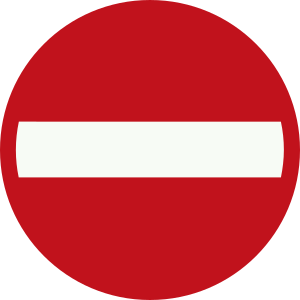
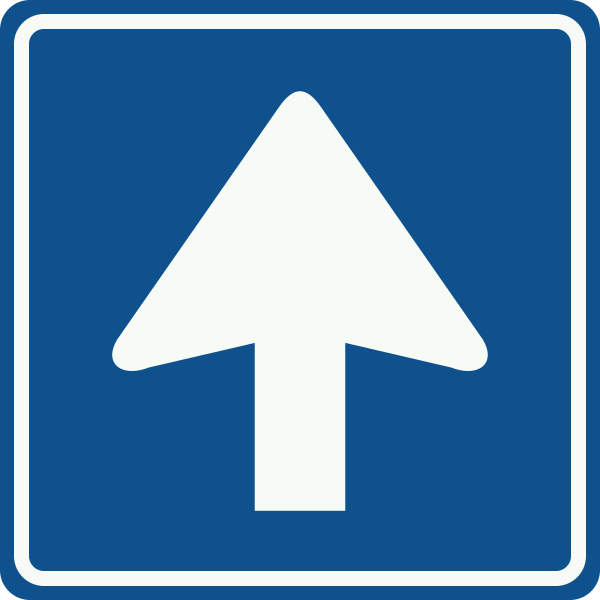
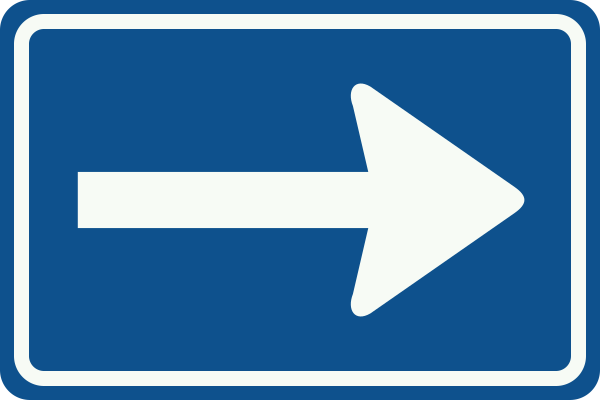
| Sign | What it looks like | Meaning |
|---|---|---|
| C2 | Round, red with a white bar | One-way street, closed in this direction to vehicles, horse riders and people leading animals or livestock |
| C3 | Square, blue with a white arrow | One-way street |
| C4 | Rectangular, blue with a white arrow | One-way street |
Sign C2 applies to vehicles. Under Article 1, bicycles and mopeds (bromfietsen) are vehicles too. So a cyclist may not ride into a street with sign C2, unless a sub-sign (onderbord) says something else. Pedestrians are not drivers of a vehicle: sign C2 does not apply to them. You can find all prohibition signs in the overview of prohibition signs.
Difference between a one-way street and a mandatory direction
A mandatory direction (verplichte rijrichting) and a one-way street look alike, because both signs are blue with a white arrow. But they say something different.
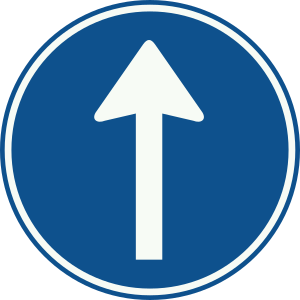
| One-way street (C3, C4) | Mandatory direction (D4 to D7) | |
|---|---|---|
| Shape of the sign | Square or rectangular | Round |
| What the sign says | This road is a one-way street | You must follow the direction the sign shows, or one of the directions shown |
| What it is about | The road itself | Your direction of travel at this point |
So a round mandatory sign says nothing about oncoming traffic. After a sign D4 you can simply be driving on a road with traffic in two directions.
Rules on a one-way street
- Keeping right is still the rule. Drivers keep as far to the right as possible (Article 3). That does not change because there is no oncoming traffic.
- Turning left. On a carriageway for drivers in one direction, you may move as far to the left as possible to turn left (Article 17). On a road with traffic in two directions you move up to the centre line of the road. More about this in getting in lane (voorsorteren).
- Turning round makes no sense. After turning round you would be driving against the direction of travel, and that is not allowed. See turning round.
- Obeying signs is compulsory. Road users must obey traffic signs that contain an order or a ban (Article 62).
The meaning of each sign is on the sign pages C2, C3 and C4. You can practise at road sign practice.
Frequently asked questions
What is a one-way street?
A road where vehicles may drive in one direction only. Signs C3 and C4 show the one-way street; sign C2 is on the side where you may not enter.
Which sign shows a one-way street?
The blue signs C3 and C4 with a white arrow. Sign C2, round and red with a white bar, means: one-way street, closed in this direction.
May a cyclist ride against the direction in one-way traffic?
Only if a sub-sign with uitgezonderd (except) and a bicycle allows it. Without a sub-sign, sign C2 applies to cyclists too, because a bicycle is a vehicle.
What is the difference between a one-way street and a mandatory direction?
A one-way street (C3, C4) says something about the road: all traffic goes the same way. A mandatory direction (round signs D4 to D7) only says which way you must go at this point.
Do you have to keep right on a one-way street?
Yes. Article 3 of the RVV 1990 applies everywhere: drivers keep as far to the right as possible. To turn left, you may get in lane on the left on a carriageway with one direction of travel.
Want to practise? Try the free questions on road signs and markings, with an explanation for every answer.
Practise this with 2,606 questions and 19 animations
Rijtheorie Hub practises exactly like the CBR exam: 50 questions, 30 minutes, pass with 44. Free to try, in 12 languages.
Download free Get it on Google Play