
Yellow line in the Netherlands: may you park or stop there?
A yellow line along the road or on the kerb is a ban. Along a broken yellow line (gele onderbroken streep) you may not park. Along a solid yellow line (gele doorgetrokken streep) you may not stop either, not even for a moment to let someone get out.
What does a yellow line on the kerb or along the road mean?
| Yellow line | Parking | Stopping to get in or out, loading and unloading | Article |
|---|---|---|---|
| Broken yellow line | Not allowed | Allowed | 24, paragraph 1 under e |
| Solid yellow line | Not allowed | Not allowed | 23, paragraph 1 under g |
The difference is in the words parking (parkeren) and stopping (stilstaan). Under the RVV 1990, parking means leaving your vehicle standing still, except for the time needed to let passengers get in or out straight away or to load or unload goods straight away. So if you only drop someone off, you are not parking. Read more about that difference in parking ban and stopping ban.
Broken yellow line: may you stop there?
Yes. May you stop at a broken yellow line? You may, as long as you only let someone get in or out straight away, or load or unload straight away. Leaving the car and walking away is parking, and that is not allowed. A broken yellow line on the kerb therefore works the same as sign E1.
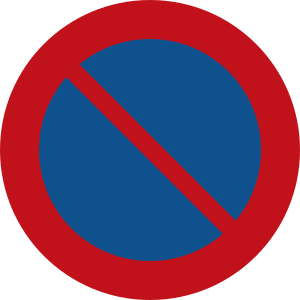
Solid yellow line: stopping is not allowed either
Along a solid yellow line you may not let your vehicle stand still. The ANWB puts it like this: loading and unloading or quickly getting out is not allowed there either. This solid yellow line works the same as sign E2.
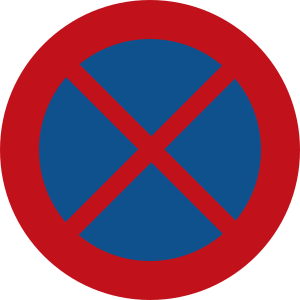
May you park at a yellow line?
No. May you park at a yellow line? Not at either of them. At the broken line only parking is banned, at the solid line both parking and stopping. So yellow lines and parking never go together, even if there is no sign. Along a yellow line, parking is always banned. The line itself is the traffic sign.
Sometimes you see a solid yellow line and a broken yellow line one after the other. Then each part of the kerb has the rule that is painted there: first a stopping ban, then only a parking ban, or the other way round.
Broken yellow line: what is the fine?
The amounts are in the list of offence codes (Tekstenbundel feitcodes) of the Public Prosecution Service (Openbaar Ministerie). The January 2026 edition gives these for a car:
| Offence | Offence code | Amount 2026 |
|---|---|---|
| Parking along a broken yellow line | R 397 g | €130 |
| Stopping along a solid yellow line | R 396 i | €130 |
Yellow lines on the road at roadworks
What do yellow lines on the road mean, in the middle of the carriageway? Those are not parking lines. At roadworks, yellow markings show the temporary lanes. Often you can still see the old white lines. Then you follow the yellow ones: temporary markings on the road surface go before the other markings on the road surface if they cannot go together (Article 63a of the RVV 1990). A yellow line in the middle of the road says nothing about the speed. You read the speed on the signs or the matrix signs.
Blue line on the kerb: not a ban but a parking disc
A blue line on the kerb or the carriageway belongs to a parking disc zone (parkeerschijfzone). In places with a blue line you may only park a car with a clearly visible parking disc (Article 25 of the RVV 1990). How to set the disc is explained in parking disc and blue zone.
Practise the yellow line and parking
Yellow lines and parking come back in the practice questions about traffic rules. Also look at sign E1 and sign E2, and read what a white solid or broken line means. Not sure about the pavement itself? See parking on the pavement.
Frequently asked questions
What does a yellow line on the kerb mean?
A yellow line on the kerb is a ban. Broken: you may not park there. Solid: you may not stop there either (Articles 23 and 24 of the RVV 1990).
What do yellow lines on the kerb mean if they are broken?
Then there is a parking ban. Letting someone get in or out straight away and loading or unloading straight away is allowed, because that is not parking.
May you park at a yellow line?
No. Along a broken yellow line and along a solid yellow line, parking is banned. At the solid line, stopping is banned too.
May you park at a yellow line if there is no sign?
No. The yellow line is a traffic sign in itself. There does not have to be a sign E1 or E2 next to it.
What does a yellow line on the kerb mean close to a bus stop?
A yellow line on the kerb means a parking ban (broken) or a stopping ban (solid) there too. At a bus stop there is also a separate rule, see stopping at a bus stop.
May you park at yellow lines to load and unload?
Parking is not allowed. Loading and unloading straight away is not parking and is allowed along the broken yellow line. Along the solid yellow line that is not allowed either.
What does a yellow kerb mean?
A yellow kerb is the same marking as a yellow line. Check whether the yellow is broken or solid. Parking at a yellow kerb is not allowed in either case.
Want to practise? Try the free questions on traffic rules, with an explanation for every answer.
Practise this with 2,606 questions and 19 animations
Rijtheorie Hub practises exactly like the CBR exam: 50 questions, 30 minutes, pass with 44. Free to try, in 12 languages.
Download free Get it on Google Play