Home › Theory guide › Parking and stopping in Amsterdam: paid parking, prohibitions and exceptions
Parking and stopping in Amsterdam: paid parking, prohibitions and exceptions
Paid parking, licence-plate parking and parking apps
Amsterdam uses expensive licence-plate parking: pay to your plate via an app and stop the session the moment you leave.
- Centrum: around 7.50 euro per hour
- No ticket: pay against your plate
- Use app: Parkmobile, Yellowbrick, EasyPark
- Start on arrival, stop on leaving
- Scan-cars check number plates instantly
- Extra assessment arrives by post, not wiper
- Often paid until midnight, 7 days
Watch out: exceptions and pitfalls
- No ticket behind the glass: many tourists buy a machine ticket and put it on the dashboard; in Amsterdam only your number plate being in the system counts, a slip behind the glass means nothing if the payment is not linked to your plate.
- Forgetting to stop the session in the app costs money: it keeps running until you end it, so you keep paying while your car is already parked at home.
- Entering the wrong plate (for example a 0 instead of an O, or copying a foreign plate incorrectly) counts as unpaid and triggers an assessment, even though you did pay.
- Times differ per street: in one street paid parking ends at 19:00 and round the corner not until midnight; always read the sub-plate for that exact spot.
- On Sundays and public holidays Amsterdam usually still charges for parking, unlike many other municipalities where it is then free.
Permit zones, parking garages and Park and Ride
P+R on the city edge is by far the cheapest: park and continue by public transport, provided you check in and out.
- Many streets are permit-holder areas
- Without permit you pay the high street tariff
- Sub-plate shows whether parking is allowed
- Garage: drier, safer, daily maximum
- P+R: heavily reduced day rate
- P+R condition: continue by transit, check in/out
- Fail the conditions? Full tariff applies
Watch out: exceptions and pitfalls
- P+R is only cheap with public transport: if you do not travel on by public transport or fail to check in and out per the rules, you lose the P+R rate and pay a lot extra.
- A resident's visitor parking is not automatically active: a resident must register your number plate digitally, otherwise you simply stand at full tariff or even illegally.
- In a permit street the sub-plate 'permit holders only' can mean paying is not even possible and your car may not stand there at all.
- Garages have a maximum clearance height; vans, campers and cars with a roof box or bikes on the roof often do not fit.
- Popular garages and P+R sites can be full on busy days; reserve or check availability in advance via the municipal website or app.
Blue zone and the parking disc
In a blue zone a parking disc must be visible behind the glass, arrival time rounded up to the next half hour.
- Only for limited time, see the sign
- Disc required, clearly readable behind glass
- Round arrival time up to next half hour
- Do not secretly move the disc later
- Sign shows max time and applicable days
- Rare in centre, common in outer districts
- Always keep a disc in the car
Watch out: exceptions and pitfalls
- Arrival time, not departure time: many people accidentally set the time they want to leave; you are meant to enter the arrival time, rounded up to the half hour.
- Moving the disc afterwards is not allowed: turning the time back to stay longer is fineable and enforcers watch for exactly that.
- No disc to hand: without a parking disc you may not park in a blue zone, not even 'just briefly'.
- The blue zone often applies only on certain days and hours; outside those times you need no disc, but check that on the sign.
- Do not confuse the free blue zone with an ordinary paid-parking street; in central Amsterdam a parking disc does not help you, there you simply must pay by number plate.
Where you may not park: junctions, bends, driveways and yellow lines
Even without a sign: no parking within 5 metres of a junction, in front of driveways, at a yellow line or sharp bend.
- Not on or within 5 metres of a junction
- Not in front of a driveway or exit
- Broken yellow line means no parking
- Not in sharp bends or blocking view
- Emergency vehicles must be able to pass
- Park only within the marked bays
- Outside bays or half on pavement: fine
Watch out: exceptions and pitfalls
- Those five metres apply even without a line or sign: people often think 'there is nothing here, so it is allowed', but on a junction and within five metres parking is always forbidden.
- Standing in front of a driveway is not allowed, not even 'briefly', not even if it is your own driveway and no one else seems bothered.
- Parking half on the pavement or outside the bay to gain space is illegal parking and is actively fined in Amsterdam.
- Broken yellow line = no parking (loading/unloading and dropping off briefly is allowed), continuous yellow line = you may not even stop there; those two are often confused.
- On narrow canals and in low-traffic streets the municipality may apply extra towing policy; a wrongly parked car is gone faster than you think there, with high towing costs.
No stopping versus no parking: loading, unloading and setting down passengers
At a no-parking sign you may still briefly stop to board or load; at a no-stopping sign even that is forbidden.
- Parking = standing without direct boarding or loading
- Stopping = short, actively boarding or loading
- No-parking: 1 red stripe or broken yellow line
- There brief stopping to load/board is allowed
- No-stopping: 2 red stripes or solid yellow line
- There you may not pause at all
- Loading = heavy goods, continuous ongoing activity
Watch out: exceptions and pitfalls
- One stripe versus two stripes: the round sign with one diagonal stripe is no parking (brief stopping allowed), the sign with a cross (two stripes) is no standing (stopping at all is not allowed).
- Yellow line rule: broken yellow = no parking, continuous yellow = no standing; this is the street version of those same two signs.
- Loading and unloading is not a parking free pass: you must actually be busy in one continuous go; the moment you lock the door and walk off you are parking and breaking the restriction.
- Setting down and picking up passengers is allowed very briefly, also at a no-parking restriction, but not at a no-standing restriction, on a cycle lane, in a bend or at a crossing.
- In Amsterdam many places have window times for loading and unloading (for example only early in the morning); outside those times you may not stand there even for loading and unloading.
Canals, disabled parking and special Amsterdam situations
Along a canal: in gear or P, handbrake firmly on and front wheels towards the kerb, so the car cannot roll into the water.
- Canal: put car in gear or P
- Handbrake firmly on, front wheels to kerb
- Be extra careful reversing into a waterside spot
- Disabled bay: only with valid card visible
- Plate on sub-plate: that one resident only
- Watch charging bays, taxis and unloading spots
- Never stop on or between tram rails
Watch out: exceptions and pitfalls
- Along the canal: handbrake firmly on, in gear or in P, and wheels turned towards the kerb; this small habit stops a rolling car from going into the water.
- A disabled card gives no right to a bay with a number plate on the sub-plate; that is exclusive to that resident and forbidden to you, even with a card.
- Parking on a charging bay without charging, or staying once your car is full, is not allowed; those bays are only for electric cars actually charging.
- Never park or stand on or between tram rails or on a bus lane; you block public transport and are towed away almost immediately.
- Taxi ranks and coach spots are not ordinary parking bays; as a non-taxi or non-coach you may not stand there, not even briefly.
- Near water never rely on a weak handbrake alone; when in doubt check that the car is truly held before you get out.
Want to practise? Try the free questions on traffic rules, with an explanation for every answer.
Signs for this topic
The signs that belong to this chapter, with their meaning:
 E1: no parking
 E2: no stopping/standing
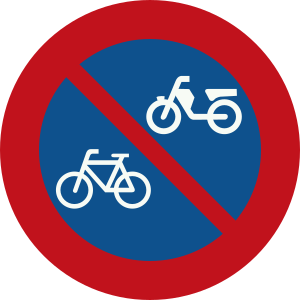 E3: no placing of bicycles and mopeds
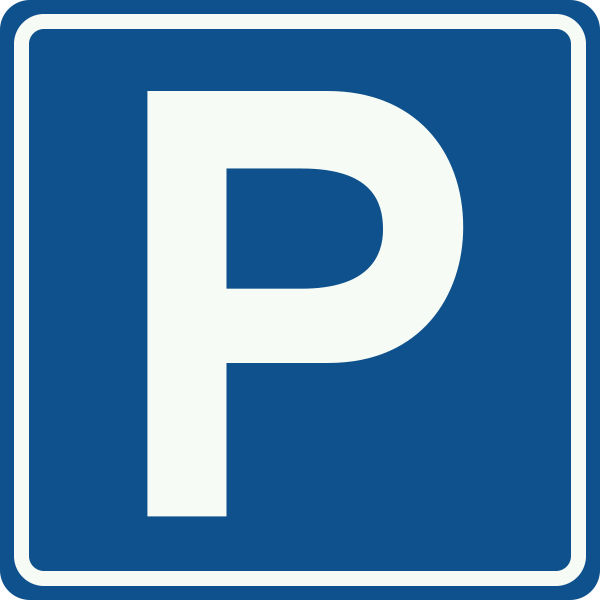 E4: parking facility / parking permitted
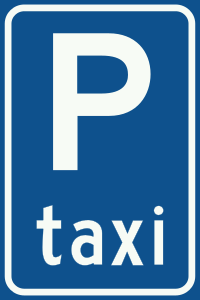 E5: taxi stand / taxi rank
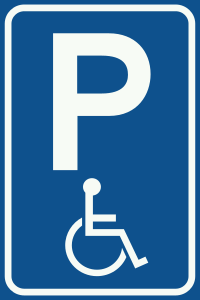 E6: disabled parking space
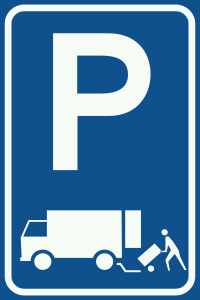 E7: space intended for the immediate loading
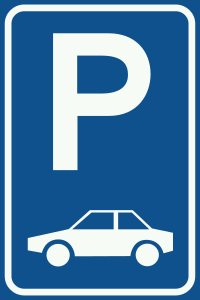 E8: parking facility reserved only for the
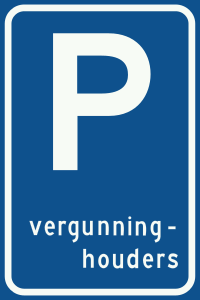 E9: parking facility reserved for permit holders only
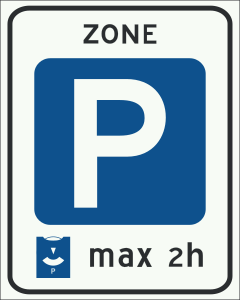 E10: parking disc zone
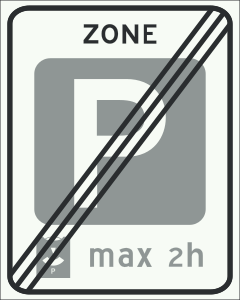 E11: end of parking disc zone with
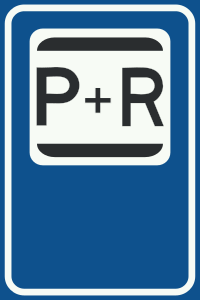 E12: parking facility for people transferring to public transport
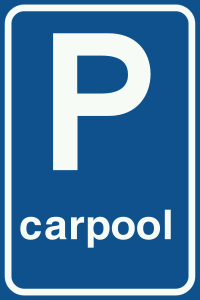 E13: parking facility for carpoolers
Practise this with 2,609 questions and 19 animations
Rijtheorie Hub practises exactly like the CBR exam: 50 questions, 30 minutes, pass with 44. Free to try, in 12 languages.
Download free