
No parking (E1) or no stopping (E2): what is still allowed?
The no parking sign (E1, niet parkeren) and the no stopping sign (E2, verboden stil te staan) look alike, but they ask different things of you. The round sign with one diagonal stripe is a parking ban: a short stop is allowed. The sign with a cross (two stripes) is a stopping ban: you may not stop at all. Below, for each sign, is what you may still do, which yellow lines mean the same, and where you may not park even without a sign.
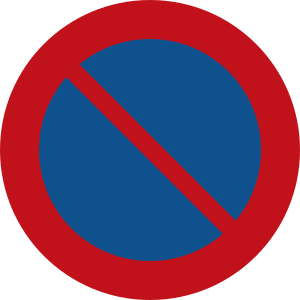
Sign E1: no parking
No parking (stopping to load/unload or let passengers in/out remains permitted)
The blue disc with one red slash says: quick drop-off is fine, but don't park your car for a nap here. Parking no, brief stop yes.
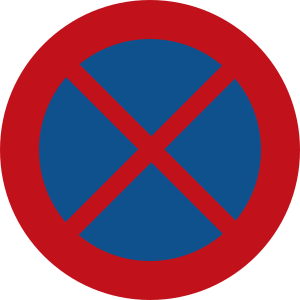
Sign E2: no stopping
No stopping/standing (parking, loading/unloading and letting passengers in/out are all prohibited)
The red ring slashed by a single cross shouts 'no standing still, ever': no parking, no loading, not even a heartbeat at the kerb.
No parking or no stopping: what is still allowed?
- Parking = standing without direct boarding or loading
- Stopping = short, actively boarding or loading
- No-parking: 1 red stripe or broken yellow line
- There brief stopping to load/board is allowed
- No-stopping: 2 red stripes or solid yellow line
- There you may not pause at all
- Loading = heavy goods, continuous ongoing activity
Exceptions and pitfalls
- One stripe versus two stripes: the round sign with one diagonal stripe is no parking (brief stopping allowed), the sign with a cross (two stripes) is no standing (stopping at all is not allowed).
- Yellow line rule: broken yellow = no parking, continuous yellow = no standing; this is the street version of those same two signs.
- Loading and unloading is not a parking free pass: you must actually be busy in one continuous go; the moment you lock the door and walk off you are parking and breaking the restriction.
- Setting down and picking up passengers is allowed very briefly, also at a no-parking restriction, but not at a no-standing restriction, on a cycle lane, in a bend or at a crossing.
Yellow lines: the same two bans, along the kerb
You want to leave your car in front of a shop and see a broken yellow line along the kerb. What does that mean for you?
A broken yellow line means a parking ban: parking is not allowed, but a brief stop (boarding/alighting, loading/unloading) is permitted. A continuous yellow line is a stopping ban. Source: RVV 1990 art. 24 (gele onderbroken streep)
A continuous yellow line runs along the edge of the carriageway. You want to quickly let your passenger out. What does that line mean for you?
A continuous yellow line along the edge of the carriageway means a stopping ban: stopping is forbidden, not even briefly to let someone in or out. A broken yellow line is a parking ban, where a brief stop is allowed. Source: RVV 1990 Art. 23 (gele markering)
Where you may not park, even without a sign
- Not on or within 5 metres of a junction
- Not in front of a driveway or exit
- Broken yellow line means no parking
- Not in sharp bends or blocking view
- Emergency vehicles must be able to pass
- Park only within the marked bays
- Outside bays or half on pavement: fine
Exceptions and pitfalls
- Those five metres apply even without a line or sign: people often think 'there is nothing here, so it is allowed', but on a junction and within five metres parking is always forbidden.
- Standing in front of a driveway is not allowed, not even 'briefly', not even if it is your own driveway and no one else seems bothered.
- Broken yellow line = no parking (loading/unloading and dropping off briefly is allowed), continuous yellow line = you may not even stop there; those two are often confused.
All 13 parking and stopping signs
Jump to: E1 · E2 · E3 · E4 · E5 · E6 · E7 · E8 · E9 · E10 · E11 · E12 · E13
E1 — No parking (stopping to load/unload or let passengers in/out remains permitted)
Memory hook: The blue disc with one red slash says: quick drop-off is fine, but don't park your car for a nap here. Parking no, brief stop yes.
E2 — No stopping/standing (parking, loading/unloading and letting passengers in/out are all prohibited)
Memory hook: The red ring slashed by a single cross shouts 'no standing still, ever': no parking, no loading, not even a heartbeat at the kerb.
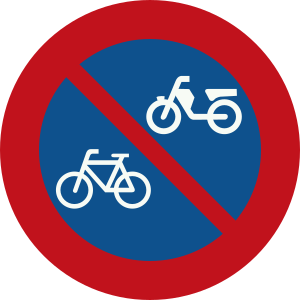
E3 — No placing of bicycles and mopeds (also applies to light mopeds and speed-pedelecs)
Memory hook: The crossed-out bicycle cries: 'Don't PARK me here!' - no two-wheeler may be left standing in this spot.
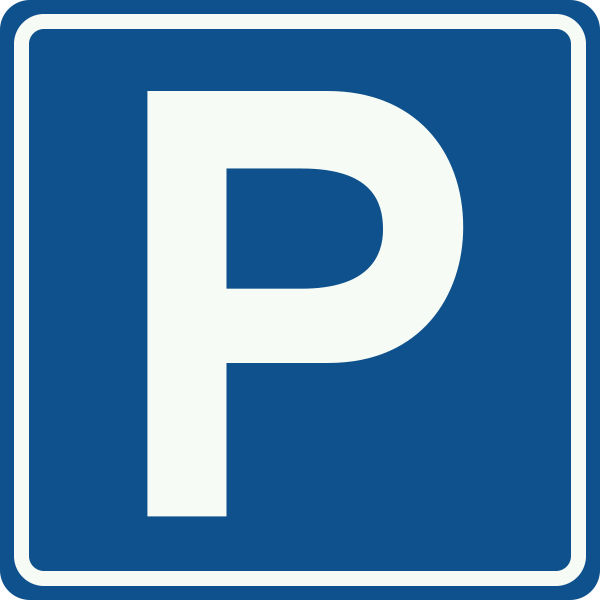
E4 — Parking facility / parking permitted
Memory hook: The big white P on blue is the friendly Porter saying: 'Park here calmly, plenty of room.'
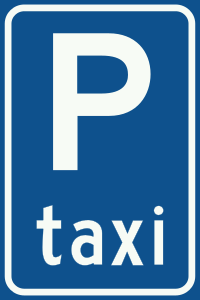
E5 — Taxi stand / taxi rank
Memory hook: See the blue letter T? T is for Taxi, exactly where the cabs line up and wait.
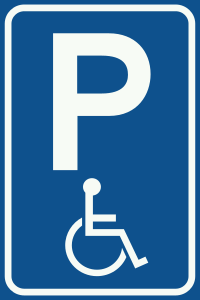
E6 — Disabled parking space (reserved for people with a disability)
Memory hook: Blue square with a wheelchair: this bay is saved with respect for someone who truly needs it. No permit, no parking.
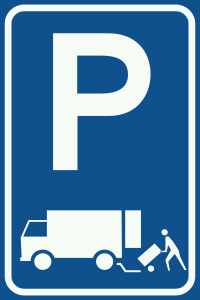
E7 — Space intended for the immediate loading and unloading of goods (parking is prohibited here)
Memory hook: The blue P with a loading icon says: drop your cargo, grab it and go; linger to park and you're in the wrong.
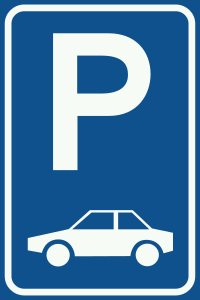
E8 — Parking facility reserved only for the vehicle category or group indicated on the sign
Memory hook: The blue P shows just one kind of vehicle drawn on it: only that guest gets a spot here, everyone else drives on.
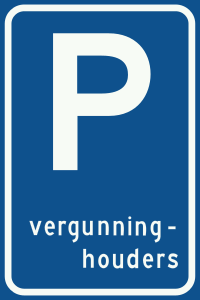
E9 — Parking facility reserved for permit holders only
Memory hook: A blue parking sign with fine print underneath whispers: only those clutching a permit ticket may leave their car here. No permit, no spot.
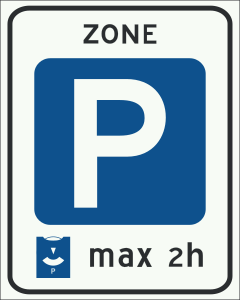
E10 — Parking disc zone: mandatory use of a parking disc at spaces marked with a blue line
Memory hook: A blue sign showing a clock-disc: wherever a blue line hugs the kerb, spin your parking disc - blue stripe below, blue disc on the dash.
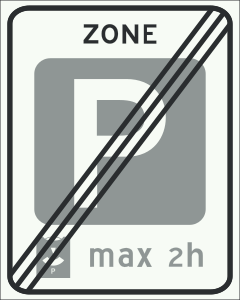
E11 — End of parking disc zone with mandatory use of a parking disc
Memory hook: The crossed-out parking clock says: 'Put your disc back in the glovebox' - the disc zone is over.
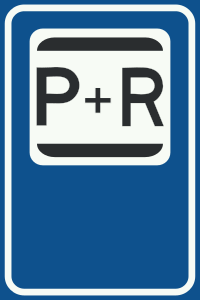
E12 — Parking facility for people transferring to public transport (Park and Ride)
Memory hook: P+R = Park and Ride: leave the car here, the bus or train handles the rest.
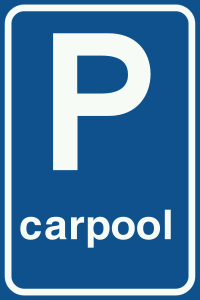
E13 — Parking facility for carpoolers
Memory hook: Two hands shaking on blue: 'Share your car, share your spot' — the parking bay for carpoolers.
Practise it
Practise recognising the signs in the free road sign quiz. Parking and stopping are part of the topics traffic rules and special manoeuvres. The full rules, including blue zones and paid parking, are in parking and stopping.
Practise this with 2,609 questions and 19 animations
Rijtheorie Hub practises exactly like the CBR exam: 50 questions, 30 minutes, pass with 44. Free to try, in 12 languages.
Download free