Rijtheorie HubPractise the CBR theory in 12 languagesFree on the App Store
Open
Home › Theory exam practice › Practise Traffic rules

Practise Traffic rules

10 free practice questions on traffic rules for the Dutch CBR car theory exam. Speeds, overtaking, lanes, lights, parking and stopping: the rules you need everywhere. After every answer you see the explanation and the source. The app has 297 questions on this topic.

What you need to know

From the theory guide: Speed limits and every exception · Special Road Types and Their Rules · Lighting: dipped beam, main beam, fog lamps, hazard lights and tunnels
10 free questions on traffic rules

Score: 0 of 0
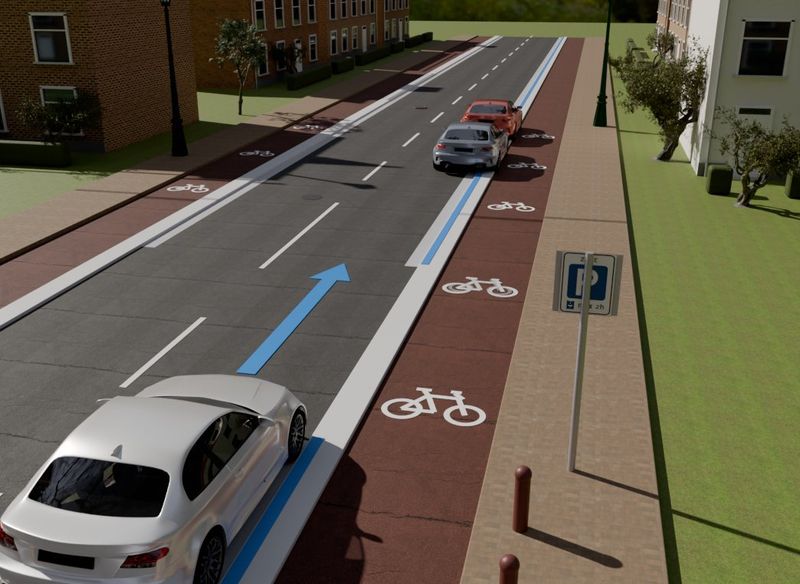
3D traffic situation for question 1

1. You are in a parking-disc zone and see a parking spot marked with a blue stripe. What must you do to park here legally?

Show in Dutch

Je bent in een parkeerschijf-zone en ziet een parkeerplaats met een blauwe streep. Wat moet je doen om hier te mogen parkeren?
Explanation: At spots with a blue stripe, you may only park with a clearly visible parking disc (art. 25 paras. 1-2 RVV 1990); without markings, parking in the zone is forbidden altogether.NL: Een parkeerschijf duidelijk zichtbaar plaatsen Source: RVV 1990 art. 25 lid 1-2
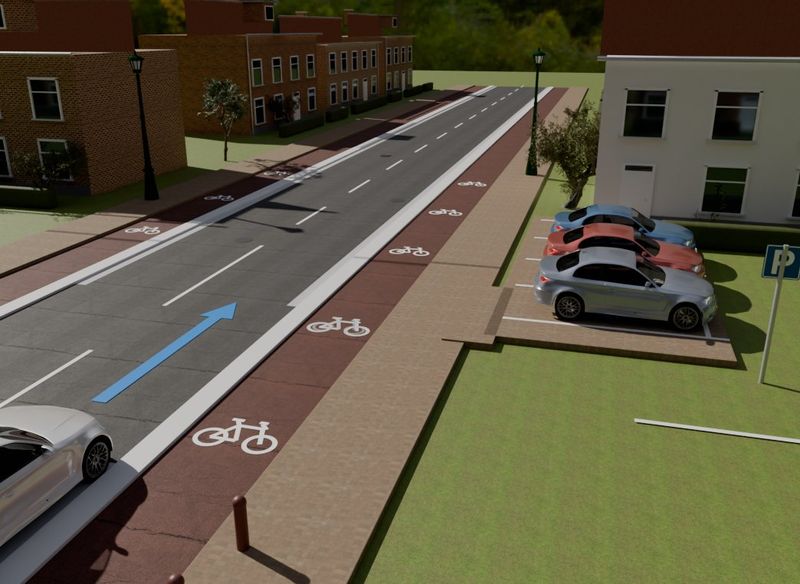
3D traffic situation for question 2

2. Marked parking bays are indicated on a road. How must you park here?

Show in Dutch

Op een weg zijn parkeervakken met belijning aangegeven. Hoe moet je hier parkeren?
Explanation: If parking bays are marked, the driver must park within them (art. 24 para. 4 RVV 1990).NL: Binnen de aangegeven vakken Source: RVV 1990 art. 24 lid 4
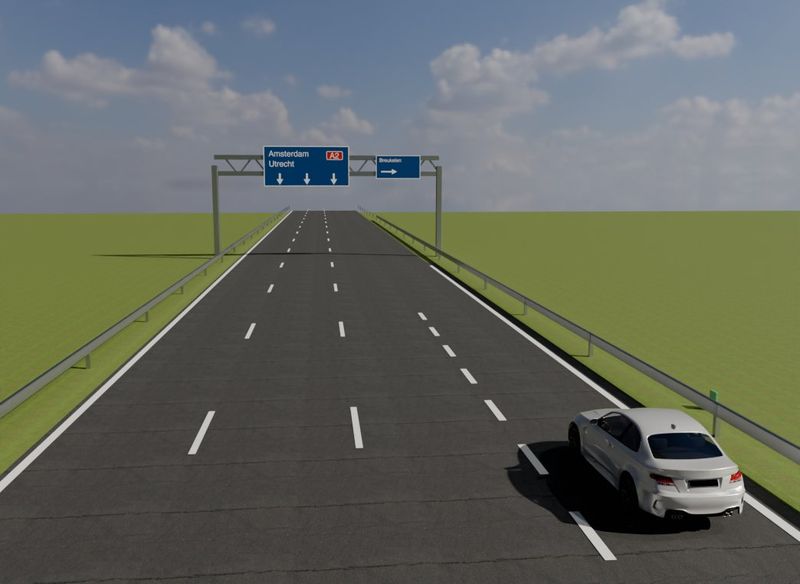
3D traffic situation for question 3

3. You are merging from the acceleration lane onto the through carriageway of the motorway. What must you do?

Show in Dutch

Je voegt in vanaf de invoegstrook naar de doorgaande rijbaan van de autosnelweg. Wat moet je doen?
Explanation: Drivers performing a special maneuver, such as merging from the acceleration lane onto the through carriageway, must give way to the other traffic (art. 54 RVV 1990).NL: Het overige verkeer op de doorgaande rijbaan voor laten gaan Source: RVV 1990 art. 54
3D traffic situation for question 4

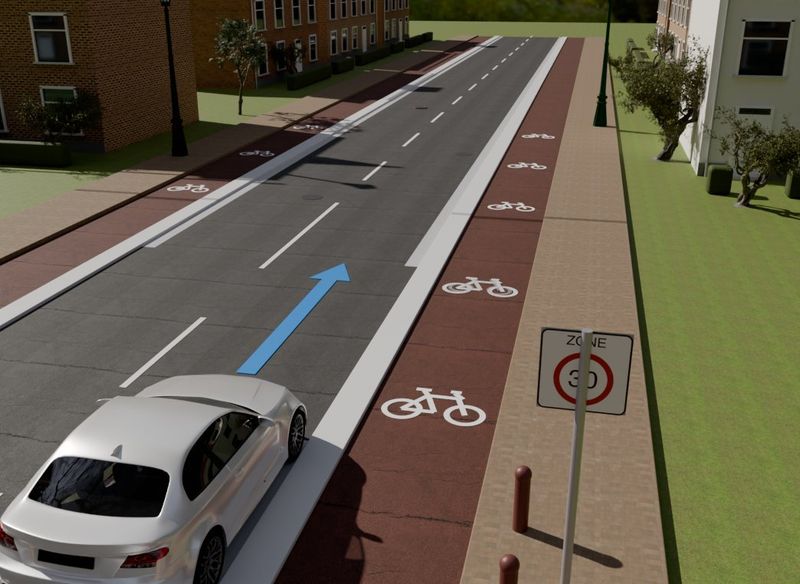
4. In the built-up area you enter this 30 zone. After two junctions you still have not seen any other speed sign. What is the maximum speed there?

Show in Dutch

Je rijdt binnen de bebouwde kom deze zone 30 binnen. Na twee kruispunten heb je nog steeds geen ander snelheidsbord gezien. Welke maximumsnelheid geldt daar?
Explanation: Art. 66 RVV 1990: if the word 'zone' appears above a sign, the sign applies in the whole area up to the sign marking the end of the zone. Junctions do not end it. The 50 km/h of art. 20 applies again only after the end-of-zone sign; 15 km/h applies only in a home zone (art. 45).NL: 30 km/h, tot je een bord 'einde zone 30' passeert Source: RVV 1990 art. 66; art. 20; bijlage 1 bord A1 (zone)
3D traffic situation for question 5

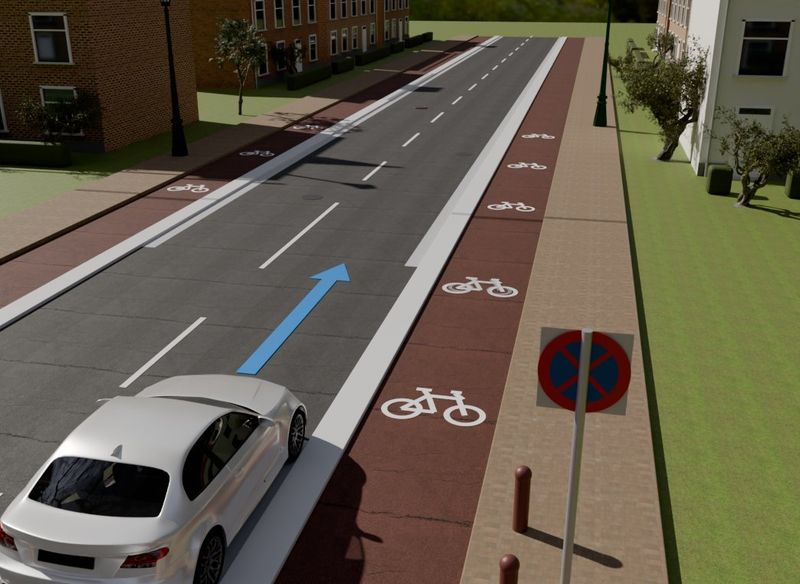
5. In this shopping street is sign E2 (no stopping). You want to stop here briefly to unload a heavy box from your car. Is that allowed?

Show in Dutch

Bij deze winkelstraat staat bord E2 (verbod stil te staan). Je wilt hier even stoppen om een zware doos uit je auto te laden. Mag dat?
Explanation: No. Sign E2 forbids stopping itself. Loading and unloading is not parking (art. 1 RVV 1990), but it is stopping, and exactly that is forbidden here. Under a no-parking sign (E1) immediate loading or unloading would be allowed.NL: Nee Source: RVV 1990 bijlage 1 bord E2; art. 1 (parkeren)
3D traffic situation for question 6

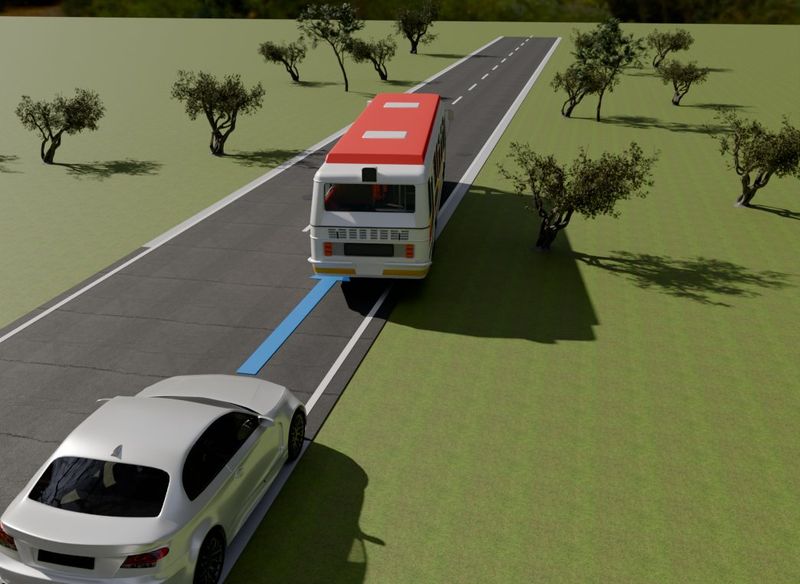
6. Outside the built-up area a bus is at a stop and indicates with its direction indicator that it wants to pull out. Are you legally obliged to give it the opportunity to pull out?

Show in Dutch

Buiten de bebouwde kom staat een lijnbus bij een halte en geeft met zijn richtingaanwijzer aan dat hij wil wegrijden. Ben je wettelijk verplicht hem de gelegenheid te geven om weg te rijden?
Explanation: No. The duty to let a bus pull out from a stop applies under art. 56(1) RVV 1990 only inside the built-up area. Outside the built-up area the bus driver performs a special manoeuvre (art. 54) and must let you go first. Making allowance for the bus of course remains sensible.NL: Nee Source: RVV 1990 art. 56 lid 1; art. 54
3D traffic situation for question 7

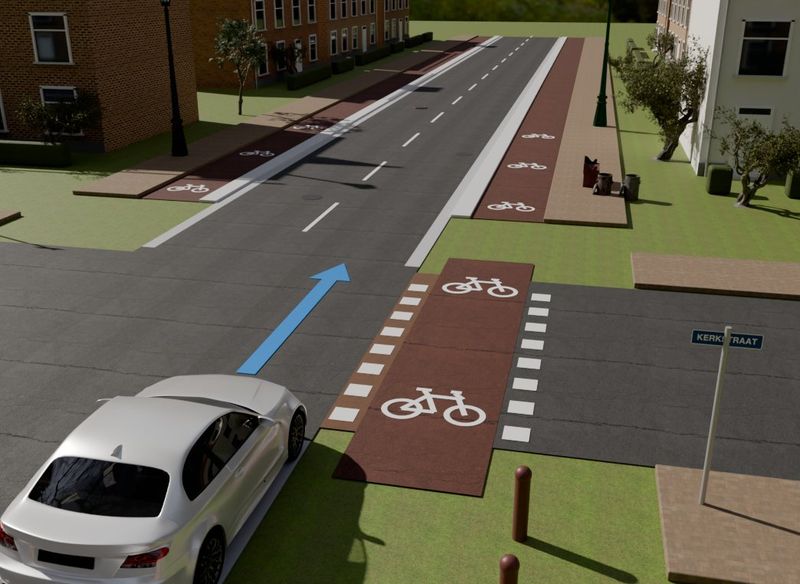
7. Your passenger wants to get out exactly at this equal junction, because his destination is on the corner. May you stop briefly on the junction for that?

Show in Dutch

Je passagier wil precies op dit gelijkwaardige kruispunt uitstappen, omdat zijn bestemming op de hoek ligt. Mag je daarvoor op het kruispunt kort stilstaan?
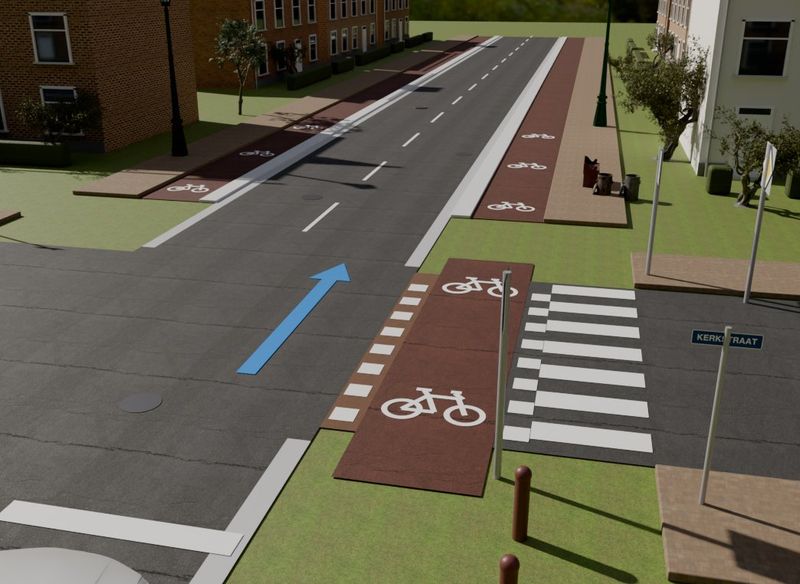
Explanation: No. Art. 23(1)(a) RVV 1990 forbids stopping on a junction, even to let a passenger out immediately. Cross the junction and stop only where it is allowed (at least 5 metres beyond the junction if you want to park, art. 24).NL: Nee Source: RVV 1990 art. 23 lid 1 onder a
3D traffic situation for question 8

8. You approach this junction with sign B7 (stop) and a stop line. You see no traffic anywhere on the crossing road. Do you still have to come to a complete stop?

Show in Dutch

Je nadert dit kruispunt met bord B7 (stop) en een stopstreep. Je ziet nergens verkeer op de kruisende weg. Moet je toch helemaal stoppen?
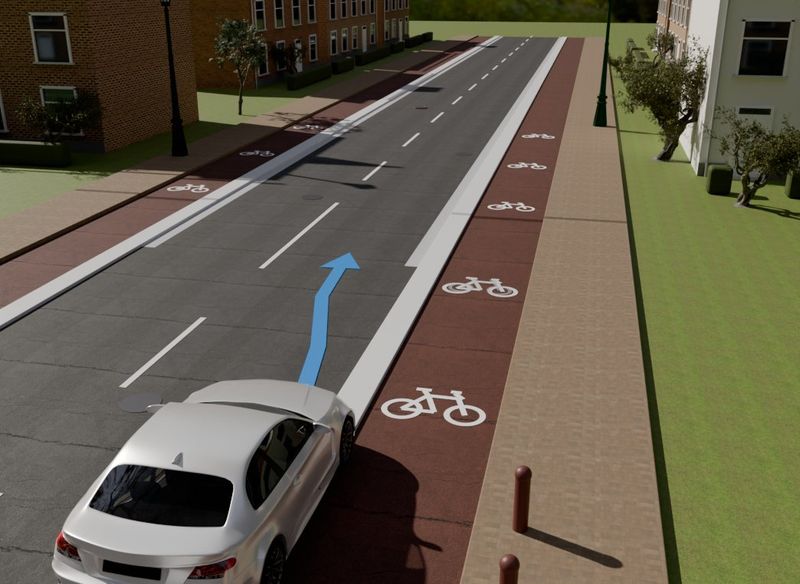
Explanation: Yes. Sign B7 means: stop and give way to drivers on the crossing road. Art. 79 RVV 1990 requires you to stop before the stop line whenever stopping is mandatory under the RVV. Seeing no traffic changes nothing.NL: Ja Source: RVV 1990 art. 79; bijlage 1 bord B7
3D traffic situation for question 9

9. You are parked at the kerb and want to pull away. The street is empty; you see no other road user at all. Do you still have to signal with your direction indicator?

Show in Dutch

Je staat geparkeerd langs de stoeprand en wilt wegrijden. De straat is leeg; je ziet geen enkele andere weggebruiker. Moet je toch een teken met je richtingaanwijzer geven?
Explanation: Yes. Art. 55 RVV 1990: drivers of a motor vehicle must signal with their direction indicator when they want to pull away. The law makes no exception for an empty street; moreover you may have overlooked someone.NL: Ja Source: RVV 1990 art. 55
3D traffic situation for question 10

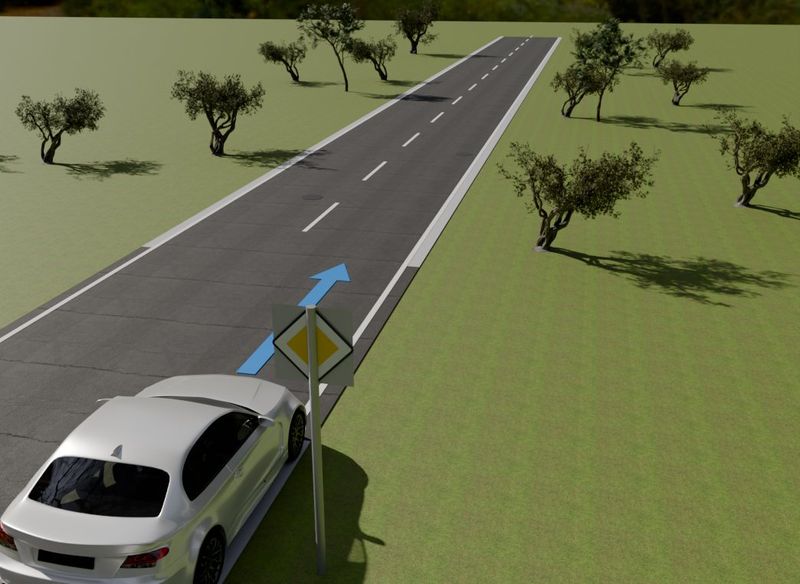
10. Outside the built-up area you are driving on a priority road (sign B1). May you stop briefly on the carriageway here to let your passenger out immediately?

Show in Dutch

Buiten de bebouwde kom rijd je op een voorrangsweg (bord B1). Mag je hier op de rijbaan kort stilstaan om je passagier direct te laten uitstappen?

Explanation: Yes. Art. 24(1)(c) RVV 1990 forbids only parking on the carriageway of a priority road outside the built-up area. Letting a passenger out immediately is not parking (art. 1) but stopping, and that is not among the stopping bans of art. 23. Do choose a spot with good visibility.NL: Ja Source: RVV 1990 art. 24 lid 1 onder c; art. 1 (parkeren); art. 23

Memory hooks for this topic

🏙️5️⃣0️⃣Inside the built-up area the limit is 50 km/h.

Picture a giant swan (shaped like a 5) floating next to an empty plate (0) in a canal: 50 through town. The swan hisses at every speeder: 'Easy, this is the built-up area!'

🐄8️⃣0️⃣Outside the built-up area the limit is 80 km/h.

Outside town a fat cow with a figure-8 pattern (two round spots) stands by a round hay-bale zero: 80 past the meadows. 'Ate-y, eighty!' she moos.

🚗🔴1️⃣0️⃣0️⃣On the autoweg (red sign with white car) the limit is 100 km/h.

Autoweg = one car on a red sign, and one car drives a hundred: a 1 with two wheels behind it = 100. Remember: red car, round hundred.

🛣️☀️1️⃣0️⃣0️⃣🌙1️⃣3️⃣0️⃣On the motorway the limit is 130 km/h, but daytime 06:00-19:00 it is 100 km/h.

On the motorway the 130 sleeps in by day: while the sun shines (6-19h) you may only do 100, and only when the moon rises do you leap to 130. Sun = hundred, moon = more.

All memory hooks for this topic

Read and practise more

Other topics

Practise Right of way

Who goes first: at uncontrolled junctions, at give-way lines and stop signs, on roundabouts and with trams, buses and emergency vehicles.

10 free questions here · 376 in the app

Practise Hazard perception

You see a traffic situation and choose what you do: brake, release the accelerator or do nothing.

21 free questions here · 219 in the app

Practise Special manoeuvres

Reversing, turning round, pulling away, merging, parking and towing.

10 free questions here · 204 in the app

Practise Vulnerable road users

Pedestrians, cyclists and moped riders, children, older people and blind or partially sighted pedestrians.

8 free questions here · 191 in the app

Practise Special conditions

Driving in rain, fog, slippery conditions, strong wind, low sun and in the dark.

9 free questions here · 196 in the app

Practise Vehicle knowledge

Dashboard warning lights, tyres, the APK (MOT), insurance and your documents.

10 free questions here · 143 in the app

Practise Environment and economical driving

Economical and clean driving, emissions, tyres and low-emission zones.

8 free questions here · 147 in the app

Practise Traffic insight

Looking ahead, keeping your distance, knowing your stopping distance and predicting what others will do.

10 free questions here · 189 in the app

Practise Motorway and autoweg

Merging and exiting, keeping right, overtaking, peak-hour lanes, matrix signs and breaking down.

10 free questions here · 157 in the app

Practise Alcohol and fitness to drive

Alcohol, drugs, medicines, tiredness, emotions and being able to see well.

10 free questions here · 138 in the app

Practise road signs

Recognising signs and road markings and knowing what they ask of you.

Quiz with all signs · 352 sign questions in the app

Practise this with 2,609 questions and 19 animations

Rijtheorie Hub practises exactly like the CBR exam: 50 questions, 30 minutes, pass with 44. Free to try, in 12 languages.

Download free