Lijnbus, autobus and T100 bus: what is the difference?
A lijnbus (scheduled bus) is a motor vehicle that runs public transport. An autobus (bus or coach) is any motor vehicle that is built for more than eight passengers. A T100 bus is an autobus that, according to its registration, is suitable for 100 km/h. The three words look alike, but the rules are different.
What is a lijnbus and what is an autobus?
With an autobus it is about how the vehicle is built: more than eight seats for passengers. So a coach (touringcar), a school bus and a city bus are all autobuses. With a lijnbus it is about the use: the vehicle runs public transport. The definition of lijnbus does not give a number of seats.
So the difference between a bus and a lijnbus is: every large bus is an autobus, but only a bus in public transport is also a lijnbus. A coach is an autobus and not a lijnbus.
What is a T100 bus?
A T100 bus (also written as T 100 bus) is an autobus whose registration certificate or the vehicle register shows that it is built for a maximum speed of 100 km/h. T100 buses from another EU country also count if the registration certificate or an inspection certificate shows that the bus is suitable for 100 km/h.
How fast may a coach drive on the motorway?
That depends on the bus. The speed of a coach without a T100 entry is at most 80 km/h. A T100 bus may drive 100 km/h (Article 22). If a lower limit applies on a road, that limit goes first: inside the built-up area (bebouwde kom) it stays 50 km/h.
| Vehicle | Special speed limit | Article |
|---|---|---|
| Autobus, not a T100 bus | 80 km/h | 22 under a |
| T100 bus | 100 km/h | 22 under b |
| T100 bus with a trailer of up to and including 3,500 kg | 90 km/h | 22 under e |
The speeds for passenger cars are in speed limit on the motorway.
May a coach use the bus lane?
Look at the word on the road surface (Article 81):
| The road surface says | Who may use it |
|---|---|
| BUS | Lijnbus, autobus and tram |
| LIJNBUS | Lijnbus and tram |
A coach is an autobus and so may use a bus lane (busbaan or busstrook) with the word BUS, but not a lane with the word LIJNBUS. A passenger car may not use either of them. Read on in bus lane: may I drive on it.
Rules for you as a car driver
- Bus at the stop. Inside the built-up area you give the driver of an autobus the chance to pull away from a bus stop when he is indicating (Article 56). That applies to every autobus, not only to a lijnbus. See bus pulling away from the stop.
- Stopping at the bus stop. At the bus stop sign you may not stop alongside the block marking. If that marking is not there, then not within 12 metres of the sign. Letting passengers get in and out straight away is allowed (Article 23).
- Carriageway along a bus lane. You may not stop on the carriageway (rijbaan) along a bus lane (busstrook) (Article 23).
Lijnbus sign: which signs are about buses?
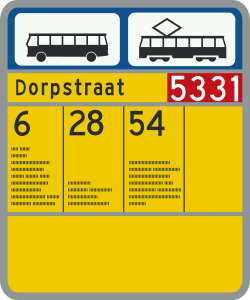
Sign L3 shows a bus stop or tram stop. Sign C7a means: closed to autobuses. If a closed road says that local traffic (bestemmingsverkeer) is allowed, then under Article 1 drivers of lijnbuses are part of that too. You can practise at traffic rules practice.
Frequently asked questions
What is a lijnbus?
A motor vehicle that is used for public transport within the meaning of the Wet personenvervoer 2000 (Article 1 of the RVV 1990). In English: a scheduled bus.
What is an autobus?
A motor vehicle that is built to carry more than eight persons, not counting the driver.
What is the difference between an autobus and a lijnbus?
Autobus says something about how the vehicle is built (more than eight passengers), lijnbus about the use (public transport). A coach is an autobus but not a lijnbus.
How fast may a T100 bus drive?
At most 100 km/h, as long as no lower speed limit applies. An autobus without a T100 entry may drive at most 80 km/h (Article 22 of the RVV 1990).
May a coach use the bus lane?
Only if the word BUS is on the road surface. A bus lane with the word LIJNBUS is for lijnbuses and trams (Article 81 of the RVV 1990).
Do you also have to let a bus pull away from the stop outside the built-up area?
That duty from Article 56 of the RVV 1990 only applies inside the built-up area.
Want to practise? Try the free questions on traffic rules, with an explanation for every answer.
Practise this with 2,606 questions and 19 animations
Rijtheorie Hub practises exactly like the CBR exam: 50 questions, 30 minutes, pass with 44. Free to try, in 12 languages.
Download free Get it on Google Play