
N road and provincial road in the Netherlands: what is it and how fast may you drive?
An N road (N-weg) is a road with a number that starts with the letter N, such as the N148. It is every numbered road that is not a motorway (autosnelweg). Many N roads are a provincial road (provinciale weg), but not all of them. How fast you may drive does not depend on the letter N but on the type of road and the signs.
What is an N road?
Rijkswaterstaat (the national road authority) explains where the letter comes from: in 1976 all roads in the Netherlands were given a letter. The motorways got the letter A, all non-motorways the letter N. So what are N roads? All numbered roads that are not a motorway. That can be an expressway, but also an ordinary road outside or inside the built-up area.
Is an N road always a provincial road?
No. What are provincial roads? They are the roads that a province manages. The Netherlands has four kinds of road authorities:
| Kind of road | Road authority |
|---|---|
| National roads (rijkswegen) | Rijkswaterstaat |
| Provincial roads | The provinces |
| Local roads | The municipalities |
| Water board roads | The water boards (waterschappen) |
Rijkswaterstaat manages most motorways (A roads), but also a number of N roads. The road overview of Rijkswaterstaat lists, for example, the N9, the N33 and the N57. If a road number is not in that overview, then according to the Rijksoverheid (the Dutch government) the province manages the road. For the traffic rules it does not matter who manages the road.
How fast may you drive on an N road?
There is no separate speed limit for N roads. The N road speed follows from the type of road:
| The N road is a... | You recognise it by | Speed limit for a car |
|---|---|---|
| Expressway | Sign G3 | 100 km/h |
| Other road outside the built-up area | No sign G1 or G3 | 80 km/h |
| Road inside the built-up area | Sign H1 with the place name | 50 km/h |
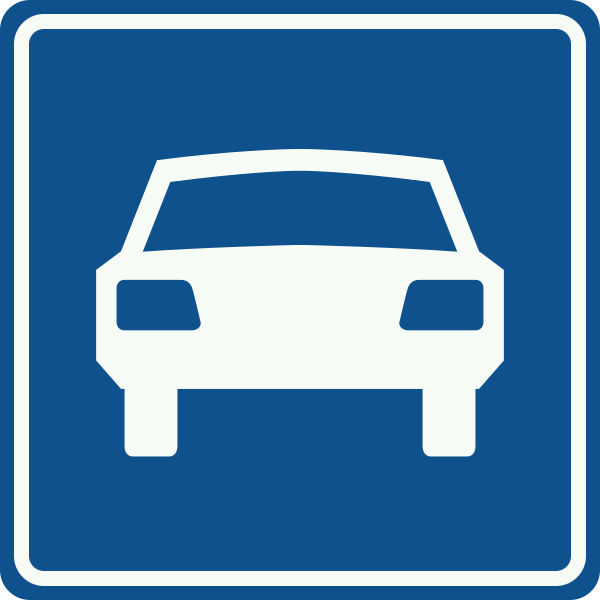
If there is a sign with another speed, that sign applies, because traffic signs go before traffic rules (Article 63). Outside the built-up area the road markings help too: double white centre lines with green in between mean 100 km/h, without green 80 km/h. The ANWB says the same: on some N roads you may drive 100 km/h, and you can see that from a sign with 100 and from the double line filled with green. If there is no centre line, the limit is 60 km/h if there are signs with 60, otherwise 80 km/h. The speeds of roads outside the built-up area are explained in detail in speed limit outside the built-up area and in recognising types of roads.
Which sign belongs to an N road?
There is no separate N road sign. You recognise the road number in two places:
- Signposts. The RVV 1990 describes the number on signposts as the route number of a non-motorway (Annex 1, chapter K).
- Hectometre posts (hectometerpaaltjes). They show the road number, for example A4 or N148, with the position along the road.
If the N road is an expressway, sign G3 stands at the start and sign G4 at the end. On an expressway you may only drive with a motor vehicle that may and can drive at least 50 km/h (Article 42), and turning round, reversing and stopping on the carriageway are banned there (Article 43). You can read about the difference from the motorway in expressway or motorway.
N roads in the Netherlands: what do you look out for?
- Oncoming traffic. If the centre line is solid, you may not overtake. See solid line and broken line.
- Parking. Outside the built-up area you may not park on the carriageway of a priority road (voorrangsweg) (Article 24, paragraph 1 under c).
- Green centre line. It belongs to a road where you may drive 100 km/h. See green line on the road.
There are practice questions about these roads at traffic rules practice.
Frequently asked questions
What is an N road?
A road with an N number. Since 1976 motorways have the letter A and all non-motorways the letter N, says Rijkswaterstaat.
How fast may you drive on an N road?
That depends on the road. On an expressway (sign G3) 100 km/h, on other roads outside the built-up area 80 km/h and inside the built-up area 50 km/h, unless a sign shows something else (Articles 20 and 21 of the RVV 1990).
Is the speed the same on all N roads?
No. N roads have no speed of their own. N roads have the speed of their road type: 100, 80 or 50 km/h, or what the signs show.
What is a provincial road?
A road that is managed by a province. The province takes care of the quality and the maintenance. The traffic rules are the same as on other roads.
How fast may you drive on a provincial road?
Outside the built-up area 80 km/h, or 100 km/h if the provincial road is an expressway. A sign with a lower speed goes first.
Which speeds apply on the different roads?
The speeds of roads for a car are: 50 km/h inside the built-up area, 80 km/h outside the built-up area, 100 km/h on an expressway and 130 km/h on a motorway, unless signs show something else (Articles 20 and 21 of the RVV 1990).
Want to practise? Try the free questions on traffic rules, with an explanation for every answer.
Practise this with 2,606 questions and 19 animations
Rijtheorie Hub practises exactly like the CBR exam: 50 questions, 30 minutes, pass with 44. Free to try, in 12 languages.
Download free Get it on Google Play