
Lane and carriageway (rijstrook and rijbaan): what is the difference?
Lane and carriageway are two different things in the Dutch traffic rules. A lane (rijstrook) is a part of the carriageway that is marked with solid or broken lines and is wide enough for a car. The carriageway (rijbaan) is the whole part of the road that is meant for moving vehicles. So a carriageway can have one or more lanes.
Lane and carriageway: the difference in one table
| Term | What it is | Example |
|---|---|---|
| Road (weg) | Everything together: carriageways, paths and verges | A street with a carriageway, a cycle path and a pavement |
| Carriageway (rijbaan) | The part of the road for moving vehicles, without the cycle paths | The asphalt between the two kerbs |
| Lane (rijstrook) | A part of the carriageway marked with lines | The left or right lane on the motorway |
| Through carriageway (doorgaande rijbaan) | The carriageway without the acceleration lanes and deceleration lanes | The lanes of the motorway that you merge onto |
A road can have more than one carriageway, for example one carriageway per direction with a verge or crash barrier in between. A cycle path is not part of the carriageway. A cycle lane (fietsstrook) is: it is a marked part of the carriageway with pictures of a bicycle. Read more in what is a cycle lane.
Lanes: the rules you need to know
- Keep right. Drivers keep as far to the right as possible (Article 3). So with more lanes in your direction you drive in the right-hand lane when you are not overtaking. In a traffic jam you do not have to (Article 13).
- Changing lanes is a special manoeuvre. You let other traffic go first (Article 54) and you indicate (Article 55).
- Solid line. You may not cross a solid line between lanes (Article 76). More about this in road markings.
- Signs per lane. If a road is divided into lanes, a road sign can apply to one or more lanes (Article 65).
What is the through carriageway?
The through carriageway (doorgaande rijbaan) is the carriageway without the acceleration lanes (invoegstroken) and deceleration lanes (uitrijstroken). An acceleration lane and a deceleration lane are separated from the through carriageway by a block marking (blokmarkering). If you drive from the acceleration lane onto the through carriageway, you let the traffic on it go first (Article 54). The hard shoulder is not part of the carriageway: it is separated from it by a solid line. See also rush-hour lane and hard shoulder.
What is a through road?
The RVV 1990 has the term through carriageway, but gives no description of a through road (doorgaande weg). So you cannot get priority from it. Whether you have priority depends on signs, give-way lines (haaientanden) and the rule of priority to the right, not on which road is the busiest or goes straight on.
How wide is a lane?
The traffic rules do not give a fixed width. The width of a lane is only in the law in words: wide enough for a motor vehicle on more than two wheels. So a narrow strip along the side where a car does not fit is not a lane.
End of lane: sign L5 and other signs
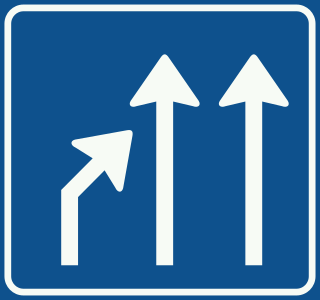
The end of lane sign is sign L5. It shows which lane ends. If you change lanes because of that, you let the traffic in the other lane go first. Sign L7 shows the number of through lanes. For a carriageway narrowing there are three warning signs: J17 (carriageway narrowing), J18 (narrowing on the right) and J19 (narrowing on the left).
Raised carriageway divider (verhoogde rijbaanscheiding)
This word is on the CBR word list. As the word says, it is a raised part that separates two carriageways from each other, for example a narrow raised edge in the middle of the road. The RVV 1990 gives no description of it.
You can practise these terms at traffic rules practice.
Frequently asked questions
What is the difference between a carriageway and a lane?
The carriageway (rijbaan) is the whole part of the road for moving vehicles. A lane (rijstrook) is a part of it that is marked with lines and is wide enough for a car (Article 1 of the RVV 1990).
Is a cycle path part of the carriageway?
No. Cycle paths and cycle/moped paths are excepted in the definition of carriageway. A cycle lane is part of the carriageway.
How wide is a lane?
The RVV 1990 does not give a number of metres. A lane must be wide enough for motor vehicles on more than two wheels to use it.
Which sign shows the end of a lane?
Sign L5: end of lane. Sign L7 shows the number of through lanes.
Who goes first when you change lanes?
The other traffic. Changing lanes is a special manoeuvre (Article 54 of the RVV 1990).
Want to practise? Try the free questions on traffic rules, with an explanation for every answer.
Practise this with 2,606 questions and 19 animations
Rijtheorie Hub practises exactly like the CBR exam: 50 questions, 30 minutes, pass with 44. Free to try, in 12 languages.
Download free Get it on Google Play