
Motorvoertuig (motor vehicle): what is it and how does it differ from a motorrijtuig?
In the Dutch traffic rules a motorvoertuig (motor vehicle) is any motorised vehicle that does not run on rails, except a moped (bromfiets), a pedal-assisted bicycle and a disability vehicle (gehandicaptenvoertuig). So a car, a motorcycle, a lorry and a bus are motorvoertuigen. A moped, a light moped (snorfiets) and a tram are not.
What are motorvoertuigen by law?
The word motorvoertuig comes from the RVV 1990, the regulations with the traffic rules and the road signs. The description has three parts: the vehicle has an engine, it does not run on rails and it is not a moped, not a pedal-assisted bicycle and not a disability vehicle.
What counts as a motorvoertuig? Among others the passenger car, the van, the lorry, the bus (autobus) and the motorcycle. The RVV 1990 literally describes a motorcycle as a motorvoertuig on two wheels.
What is a motorrijtuig?
Motorrijtuig is a word from another law: the Wegenverkeerswet 1994 (Road Traffic Act). That law covers, among other things, the driving licence and the vehicle registration. There a motorrijtuig is any vehicle that does not run on rails and that is moved completely or partly by an engine. Only the pedal-assisted bicycle is excepted (Article 1, paragraph 1 under c of the Wegenverkeerswet 1994).
So motorrijtuig is the wider term. The Wegenverkeerswet 1994 describes a moped as a motorrijtuig on two, three or four wheels with a maximum speed, set by its construction, of not more than 45 km/h (Article 1, paragraph 1 under e). That makes a moped a motorrijtuig, but not a motorvoertuig.
Difference between motorvoertuig and motorrijtuig per vehicle
| Vehicle | Motorvoertuig (RVV 1990) | Motorrijtuig (Wegenverkeerswet 1994) |
|---|---|---|
| Passenger car, van, lorry, bus | Yes | Yes |
| Motorcycle | Yes | Yes |
| Moped (bromfiets) | No, excepted in Article 1 | Yes |
| Light moped (snorfiets) | No, it is a moped | Yes |
| Speed pedelec | No, it is an electric moped | Yes |
| Microcar (brommobiel) | No, but the rules for motorvoertuigen do apply (Article 2a) | Yes |
| Pedal-assisted bicycle | No | No |
| Tram | No, runs on rails | No, runs on rails |
Is a moped a motorvoertuig?
No. Does a moped count as a motor vehicle? The RVV 1990 excepts the moped in so many words. The same goes for the light moped and the speed pedelec, because the RVV 1990 describes both as a moped: the light moped as a moped for at most 25 km/h, the speed pedelec as an electric moped with pedal assistance that keeps driving above 25 km/h too. You can read more about those two in light moped and moped: the difference.
Is a microcar (brommobiel) a motorvoertuig?
Not according to the definition: a microcar is a moped on more than two wheels with a body. Still, a microcar behaves like a motorvoertuig in traffic. Article 2a of the RVV 1990 says that the rules for motorvoertuigen and their drivers also apply to microcars, instead of the rules for mopeds. So a microcar drives on the carriageway (rijbaan) and not on the cycle/moped path.
Is a tram a motorvoertuig or a motorrijtuig?
Neither. A tram has an engine, but runs on rails. That puts the tram outside the description of motorvoertuig and also outside that of motorrijtuig. A tram is a vehicle, though, and the tram driver is a driver (bestuurder). Trams have their own rules, for example for priority for the tram.
Where do you notice the difference?
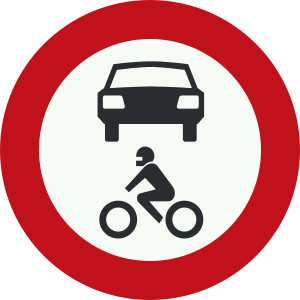
- Signs. Sign C12 means: closed to all motor vehicles (motorvoertuigen). So a moped rider, light-moped rider or cyclist may ride on there. Sign C6 closes a road to motor vehicles on more than two wheels; a motorcycle may then still enter.
- Speed. The speed limit of 50 km/h inside the built-up area (bebouwde kom) is in the law as a speed for motorvoertuigen (Article 20). For mopeds there are other speeds.
- Motorway and expressway. These are only for drivers of a motorvoertuig (Article 42).
Both words are on the CBR word list with terms that you must know for the theory exam. Practise the rules at traffic rules practice.
Frequently asked questions
Is a moped a motorvoertuig?
No. Article 1 of the RVV 1990 excepts mopeds from the motorvoertuigen. A moped is a motorrijtuig under the Wegenverkeerswet 1994.
Is a light moped (snorfiets) a motorvoertuig?
No. Under the RVV 1990 a light moped is a moped for at most 25 km/h, and mopeds are not motorvoertuigen.
Is a speed pedelec a motorvoertuig?
No. The RVV 1990 calls the speed pedelec an electric moped with pedal assistance. So it is a moped and not a motorvoertuig.
Is a tram a motorvoertuig?
No. A tram runs on rails and so falls outside the definition. For the same reason a tram is not a motorrijtuig either.
Is a motorcycle a motorvoertuig?
Yes. The RVV 1990 describes the motorcycle as a motorvoertuig on two wheels, with or without a sidecar or trailer.
Is a car a motorvoertuig?
Yes. A car is a motorised vehicle that does not run on rails and that is not one of the exceptions. A car is also a motorrijtuig.
What does the sign closed to all motor vehicles mean?
That is sign C12. Drivers of a motorvoertuig may not enter the road. If it is a sign that bans motor vehicles on more than two wheels, it is sign C6.
Want to practise? Try the free questions on traffic rules, with an explanation for every answer.
Practise this with 2,606 questions and 19 animations
Rijtheorie Hub practises exactly like the CBR exam: 50 questions, 30 minutes, pass with 44. Free to try, in 12 languages.
Download free Get it on Google Play