Dutch motorway signs: exit number, hectometre post, fork and diversion
Dutch motorway signs tell you four things: which road you are on, where you are, which exit or fork is coming and what to do if the road is closed. You see the start of the motorway (autosnelweg) from sign G1. The blue direction signs with an exit number, the green hectometre posts and the matrix signs above the road do the rest.
Which Dutch motorway signs must you know?
| Sign or signal | What it tells you |
|---|---|
| G1 and G2 | Start and end of the motorway |
| Direction sign with exit number | Which exit is coming, with distance and place names |
| Fork sign at an interchange (knooppunt) | The motorway forks, you stay on the motorway network |
| Hectometre post (hectometerpaaltje) | Road number and position along the road, every 100 metres |
| Electronic sign (signaleringsbord, matrix sign) | Speed, green arrow, white arrow or red cross per lane |
| L14 | Emergency bay, only for emergencies |
| U with a number | Fixed alternative route if the motorway is closed |
| Yellow signs | Temporary diversion during roadworks |
Which motorway sign is at the start and the end?
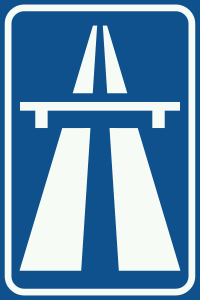
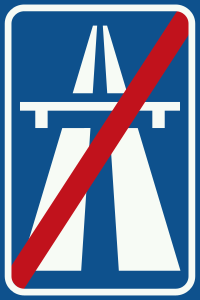
The road sign for the motorway is officially called sign G1. Sign G2, the same sign with a red stripe, is the end of motorway sign. Past G1 the rules of the motorway apply: you may not turn round, not reverse and not stop on the carriageway (Article 43). If you are looking for the sign for car and motorway, you mean sign G1 (motorway, autosnelweg) or sign G3 (expressway, autoweg). You can read the difference in expressway or motorway and in signs for road types.
Exit number: the sign with the number of the exit
The exit number (afritnummer) is on the blue direction signs along the motorway. The RVV 1990 describes such a direction sign as a sign with the distance to the exit (afrit), the exit number and the places that you reach via that exit. The top place name is the name of the exit (Annex 1, sign K2). So with the exit number sign you know well in time which exit you need.
After that the CBR teaches you this order: move to the lane next to the deceleration lane about 600 metres before the exit and indicate about 300 metres in advance. There is more about that in exiting and taking the motorway exit.
Sign for a fork in the motorway: exit or interchange?
Along the motorway there are different marker posts at an exit and at a fork (splitsing). Veilig Verkeer Nederland (the Dutch road safety organisation) explains the difference like this: at an exit you leave the motorway network, at a fork at an interchange you do not. So if you see the motorway fork sign, you only choose another motorway. The blue sign L6 (fork) shows with arrows how the lanes separate.
Hectometre post: where are you?
The green hectometre posts stand every 100 metres. On the post are the road number (for example A4), the hectometre reading (for example 50.8) and the carriageway: Re for right (rechts) or Li for left (links). A black letter on a yellow background means that you are on a slip road onto or off the motorway, a parallel carriageway or a connecting road. If you break down, you pass on all the details of the post, then the emergency services find you faster. Also read what to do if you break down on the motorway.
Electronic signs: the matrix signs above the motorway
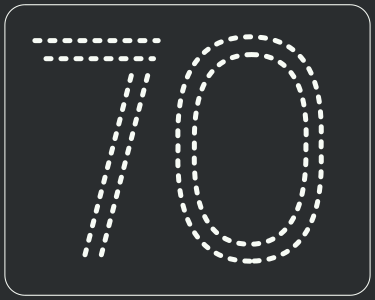
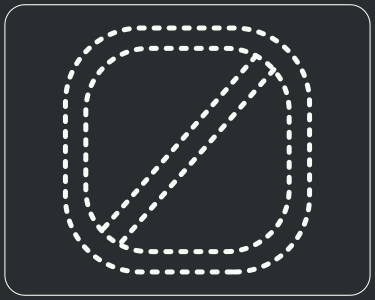
A signaleringsbord is an electronic sign on which traffic signs can be shown (Article 64a). On matrix signs on the motorway you mostly see:
- A speed (sign A3): this is a maximum speed. If a normal sign and the electronic sign both show a speed, the lowest applies (Article 63b).
- A green arrow: you may use the lane (Article 73).
- A white arrow: advance warning of a red cross.
- A red cross: you may not use the lane.
- Sign F9: end of all bans that were shown on the electronic sign.
There is more explanation in matrix signs and variable speed.
Emergency bay sign and end of hard shoulder sign
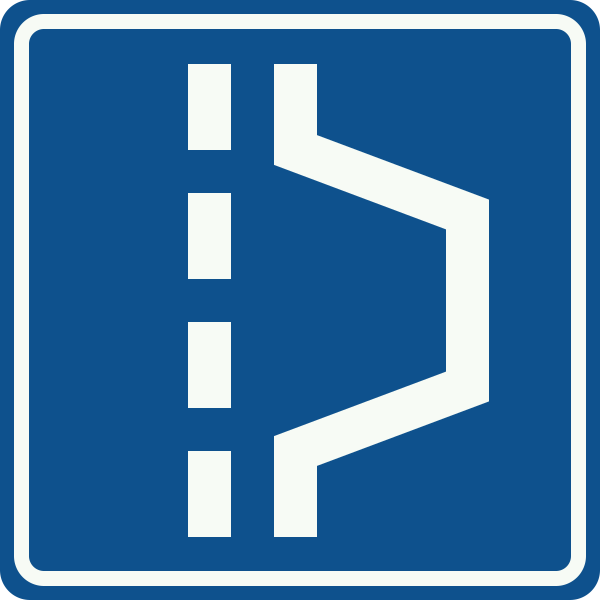
The emergency bay sign (vluchthaven) is sign L14. An emergency bay and a hard shoulder (vluchtstrook) are meant for emergencies (Article 1 and Article 43, paragraph 3). A break or a phone call is not an emergency.
An end of hard shoulder sign is not in Annex 1 of the RVV 1990. The sign that you see along the road is a marker post. Veilig Verkeer Nederland describes the hard shoulder sign like this: the hard shoulder is interrupted or narrow. That is also the sign for a narrowing hard shoulder. So if you drive there with a breakdown, you cannot count on a full hard shoulder.
Alternative route sign and diversion sign: the U and the yellow signs
If the motorway is closed after an accident, you follow the fixed alternative route (uitwijkroute). You recognise the alternative route sign by the letter U with a number. Each route has its own number. If you follow the U signs, the diversion brings you back onto the motorway, says Rijkswaterstaat (the national road authority).
With planned roadworks it works differently. Then there is a diversion sign (omleiding) in yellow: Rijkswaterstaat marks diversions with yellow signs along the road. If you see a yellow sign with a black arrow, a letter or a place name, that is the diversion route sign that leads you to your destination. For such a road diversion sign the rule is: keep following the same yellow signs until the route ends.
Viaduct sign: how high is the underpass?
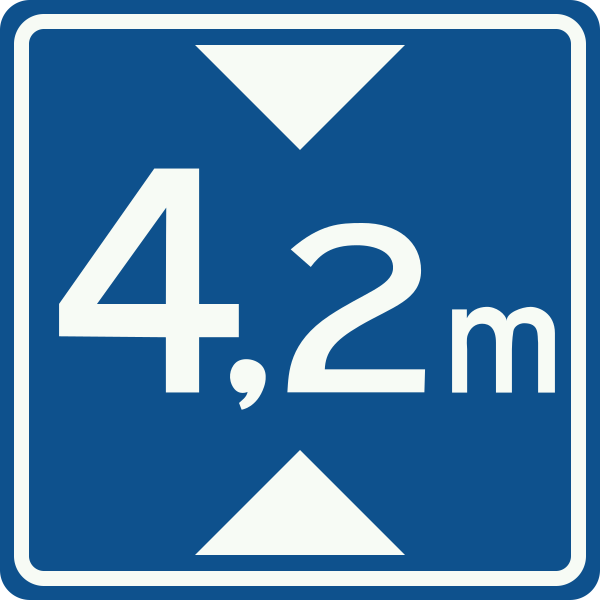
The viaduct road sign that you must know is sign L1: height of the underpass. If there is a sign with a height under the viaduct, that is the height of the underpass. On direction signs along normal roads there can also be a viaduct symbol (Annex 1, sign K5). That symbol belongs to the route and is not a ban.
What is through traffic and what does the through traffic sign mean?
The meaning of through traffic (doorgaand verkeer) is: traffic that drives on through here and has its destination somewhere else. The RVV 1990 gives no definition of its own. The law does know the opposite, local traffic (bestemmingsverkeer): drivers who need to be at an address on this very road (Article 1). In the law, the through carriageway (doorgaande rijbaan) is the carriageway without the acceleration lanes and deceleration lanes.
A direction sign with the text doorgaand verkeer points out the route for everyone who has to go further. Such a sign is part of the signposting and contains no order or ban. So you only have to obey traffic signs that contain an order or a ban (Article 62), such as a road closure sign on the other route.
Practise road signs on the motorway
All the rules of the motorway are in the guide to the motorway. You can find the signs themselves at sign G1 and in the overview of all road signs. You practise questions about motorway signs at motorway and expressway practice.
Frequently asked questions
What is the motorway sign?
The motorway sign is sign G1: a blue sign that shows the start of the motorway. Sign G2 shows the end. In addition there are direction signs, hectometre posts and matrix signs along the motorway.
Is the through traffic sign compulsory?
No. A direction sign for through traffic is signposting and not an order. You are only obliged to obey traffic signs that contain an order or a ban (Article 62 of the RVV 1990).
Is there an end of hard shoulder road sign?
Not in Annex 1 of the RVV 1990. Along the road there is a marker post that, according to Veilig Verkeer Nederland, shows that the hard shoulder is interrupted or narrow.
Orange sign with an arrow and a dot: what does it mean?
That is sign K14: the route for the transport of certain dangerous substances. The sign only points out that route and contains no rule for other traffic.
Does traffic going straight on always have priority?
No, not always. If you turn, you let traffic that goes straight on along the same road go first (Article 18 of the RVV 1990). At a junction with another road the normal rules apply: signs, give-way lines (haaientanden), traffic lights or priority to the right. See turning and priority.
Does the priority for traffic going straight on also apply to a pedestrian?
Yes. Article 18 speaks of traffic, and that means all road users. So if you turn, you also let a pedestrian who goes straight on along the same road go first.
May you make a phone call in an emergency bay?
Only in an emergency, for example to ask for help if you break down. The emergency bay is meant for emergencies (Article 43, paragraph 3 of the RVV 1990).
Want to practise? Try the free questions on motorway and autoweg, with an explanation for every answer.
Practise this with 2,606 questions and 19 animations
Rijtheorie Hub practises exactly like the CBR exam: 50 questions, 30 minutes, pass with 44. Free to try, in 12 languages.
Download free Get it on Google Play