Home › Theory guide › Motorway Driving: Joining, Leaving, Keeping Right and the Exceptions
Motorway Driving: Joining, Leaving, Keeping Right and the Exceptions
Joining via the acceleration lane and priority
As the merging driver YOU must adapt and find the gap; through traffic need not give way.
- Match your speed to motorway traffic
- Check mirrors, blind spot, signal left
- You find the gap, not through traffic
- Merge left onto the carriageway
- Use the full length of the acceleration lane
- After merging, keep right at road speed
Watch out: exceptions and pitfalls
- No legal priority: many learners believe the motorway must brake for them. The opposite is true — the merging driver adapts. In a collision while merging you, the joiner, are almost always liable.
- Zip-merging (ritsen) does NOT apply here the way it does at a lane narrowing. Zip-merging alternately is compulsory at an approaching lane drop; joining from the acceleration lane is a separate manoeuvre where you find the gap.
- Do not crawl into the taper and never stop on the acceleration lane to 'wait for a gap' — that is dangerous and causes rear-end crashes; if there really is no gap, adjust your speed but keep moving.
- Amsterdam trap: short acceleration lanes on the A10 ring (e.g. at busy junctions such as the S-exits, Coenplein interchange, Watergraafsmeer) give little room; pick your speed early because you have fewer metres than on a rural motorway.
- At weaving sections (weefvak, where joining and leaving traffic cross the same lane — common on the A10) you must watch both mergers and leavers — extra mirror checks and shoulder glances.
- Always signal left when merging, even if 'everyone can see you anyway'; without a signal a collision is more easily judged to be your fault.
Leaving the motorway and taking the exit
Be in the right lane early and slow down only on the exit lane, not the carriageway.
- Signs at 1200/900/600/300 m before exit
- Be in the right-hand lane in good time
- Signal right, check mirror and blind spot
- Slow only on exit lane, stay up to speed
- Watch tight curves and yellow advisory speeds
- Exit ends at junction/lights: give way
Watch out: exceptions and pitfalls
- No braking on the through carriageway: slowing belongs on the exit lane. Braking hard on the motorway itself for the exit creates danger and fails the exam.
- Missed your exit? Drive on to the next one. Never reverse, never stop, and absolutely never turn around or use the emergency lane to get back — that is prohibited and lethal.
- Some exits have a left-hand exit lane (leaving to the left), especially at interchanges and occasionally on the A10; read the signs carefully because the default assumption 'exits are always on the right' is wrong there.
- At interchanges the road sometimes splits without a real deceleration lane (a carriageway split); you must choose the correct lane early from the signage, because switching later may be impossible or dangerous.
- Amsterdam trap: the A10's S-exits (S101 to S118) come in quick succession and the exit curves are short and sharp with traffic lights right behind them — queues on the exit easily back up onto the emergency lane or even the right running lane.
- Queue on the exit: if the exit is jammed, you must not sit waiting on the through carriageway with stationary traffic half on the motorway if it can be avoided; join safely and watch sharply for traffic approaching from behind.
Keep right, overtake only on the left, and the congestion exception
Keep right and overtake only on the left — except when driving in jams or columns.
- Left lanes are only for overtaking
- Undertaking (passing on the right) is banned
- In jams/columns the right may go faster
- Dense traffic: car ahead sets your speed
- Never switch right just to undertake
- Return to the right after overtaking
Watch out: exceptions and pitfalls
- Congestion exception versus deliberate undertaking: flowing along on the right in a jam is allowed; actively switching right to shoot past and then back is an offence.
- On roads with an advisory speed or inside built-up areas other rules apply; the right-passing freedom above concerns the motorway/dual carriageway specifically.
- 'Hogging the left' is also wrong: staying too long in the left lane while the right is clear is a failure to keep right and is finable; it forces others into unwanted behaviour.
- With three or more lanes you need not return all the way to the far right if you are steadily overtaking slower traffic, but as soon as there is a big enough gap on the right, you move back.
- Amsterdam trap: the A10 ring is almost permanently full at rush hour; there 'right faster than left' is the norm and examiners expect you to flow calmly in your lane rather than lane-hopping.
- Lorries and vehicles with trailers usually may not use the leftmost lane on roads with 3+ lanes (an overtaking ban for freight on some stretches); do not count on a lorry pulling left.
Minimum speed and who is allowed on the motorway
The motorway is only for vehicles that can and may drive at least 60 km/h.
- No bikes, mopeds, tractors, horses, pedestrians
- 60 km/h is an admission condition
- Needlessly slow driving is prohibited
- Day max 100 km/h (06:00–19:00)
- Night 19:00–06:00: often 130/120 per signs
- Autoweg: similar rules, usually lower max
Watch out: exceptions and pitfalls
- 100 by day, higher at night: many drivers forget the time windows. Between 19:00 and 06:00 you may only go faster where the signs say so — not automatically everywhere.
- Matrix signs over the lane always take precedence over the fixed posted speed; if the matrix shows 90 or 70, THAT is your maximum, even if a roadside sign says 100.
- Light mopeds and mopeds may never enter the motorway, not even 'just a short stretch'; on the autoweg mopeds are usually also barred unless a sign expressly permits them.
- Tractors/agricultural traffic, quads that cannot reach 60, and vehicles with too low a design speed do not belong on the motorway; check the registration requirements if in doubt.
- Driving too slowly without reason is an offence and dangerous (large speed differences cause rear-end crashes); don't do 80 on a 100 road 'to save fuel' if that makes you a blockage.
- Amsterdam trap: large parts of the A10 ring and its feeder roads have a permanent 80 km/h limit (fixed or dynamic signs, partly for air quality and noise); don't assume 100 — read the signs.
The emergency lane, breakdowns, and the peak-hour lane
The emergency lane is for emergencies only: get out on the right and stand behind the barrier.
- Never drive, stop or park on the emergency lane
- Breakdown: hazards on, steer right, engine off
- Everyone exits on the right, behind the barrier
- Don't stay in the car or between car and road
- Hectometre marker tells them exactly where you are
- Call breakdown service; 112 only for danger or injury
- Peak-hour lane open only with a green arrow
Watch out: exceptions and pitfalls
- The emergency lane is NOT a driving lane: nipping 'past the jam' or stopping to phone/urinate/set navigation is forbidden and a serious offence with a hefty fine.
- In a breakdown do not stay seated in the car and do not get out on the traffic side; most fatal breakdown accidents happen because people stay by the car on the carriageway side.
- No emergency lane present? On narrow stretches or in tunnels there is sometimes none; try to reach a lay-by or emergency bay and follow tunnel instructions (escape doors, emergency post).
- Peak-hour lane only open on a green arrow: with a red cross or dark signals the lane is closed; driving on it while closed is prohibited and a stranded car could be sitting there.
- An opened (left-hand) peak lane or 'plus lane' often has its own lower maximum speed — read the matrix; the default 100/130 does not always apply there.
- Amsterdam trap: on the A10 and feeder motorways (A1, A2, A4, A8, A9) the emergency lane is used as a peak lane on some stretches; always check the arrow/cross signals before entering, and note it can suddenly close again with stationary traffic on it.
- Emergency services, road inspectors and breakdown assistance MAY use the emergency lane; do not 'tag along' behind an emergency vehicle yourself.
Matrix signs, the red cross, lane closures, and tailgating
Obey matrix signs; a red cross means the lane is closed — leave it at once.
- Yellow flashing speed overrides the fixed limit
- Red cross = closed lane, deadly to ignore
- Slanting white arrow: leave lane to that side
- Green down arrow: lane is open
- Tailgating banned; keep a 2-second gap
- Double the distance in rain, fog or high speed
Watch out: exceptions and pitfalls
- Red cross = leave immediately: driving under a red cross is prohibited even if the lane 'still looks empty'; there may be a stationary car or crash just around the bend.
- Matrix speed overrides fixed signs: a yellow 70 or 90 with flashing lights is your maximum, not the 100/130 on the roadside post.
- A red cross above the emergency/peak lane means it is closed; do not enter it, not even in a jam.
- React in good time, not abruptly: at an arrow or approaching cross, change lanes smoothly with your indicator; cutting across at the last second is dangerous and fails the exam.
- A tailgater behind you: do not 'punish' them by braking (brake-checking can cause a chain collision and liability); create room and let them pass.
- Amsterdam trap: on the busy A10 with short weaving sections and heavy matrix signalling the displays change fast; in a crash a lane can go to red cross within seconds as you approach — keep your distance and look ahead to the gantries.
- Adaptive/dynamic speeds: on some stretches the matrix adjusts speed to traffic density; don't rely on habit, read the current sign each time.
Want to practise? Try the free questions on motorway and autoweg, with an explanation for every answer.
Signs for this topic
The signs that belong to this chapter, with their meaning:
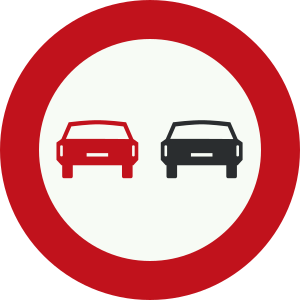 F1: no overtaking of one another by motor vehicles
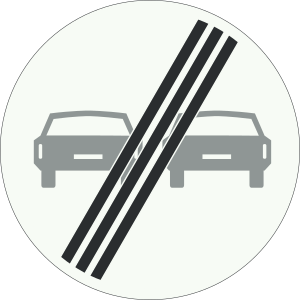 F2: end of the no-overtaking prohibition for motor vehicles
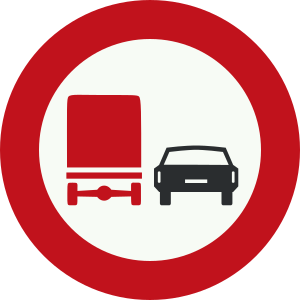 F3: no overtaking of motor vehicles by trucks (lorries)
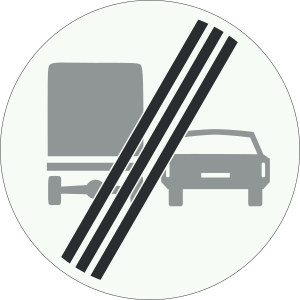 F4: end of the no-overtaking prohibition for trucks
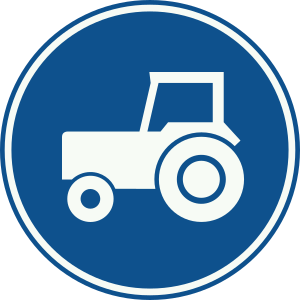 F11: compulsory use of the passing lane
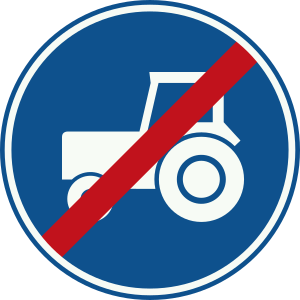 F12: end of the compulsory passing lane
 F13: carriageway or lane reserved exclusively for scheduled buses
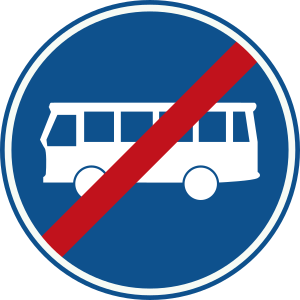 F14: end of bus lane or carriageway
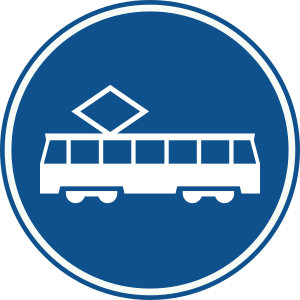 F15: carriageway or lane reserved exclusively for trams
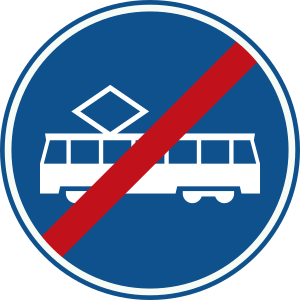 F16: end of tram lane or carriageway
 F17: carriageway or lane reserved exclusively for
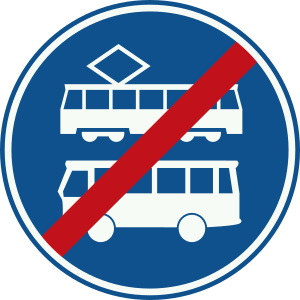 F18: end of bus and tram lane or carriageway
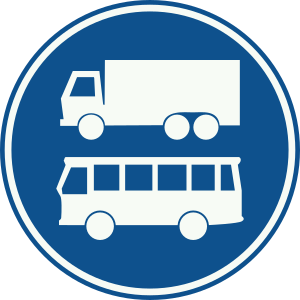 F19: carriageway or lane reserved exclusively for
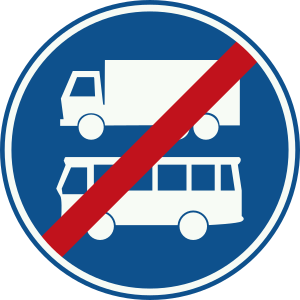 F20: end of carriageway or lane for trucks and scheduled buses
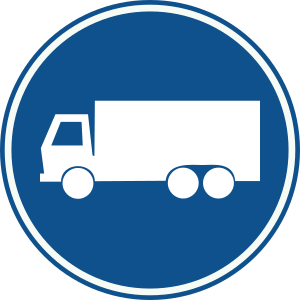 F21: carriageway or lane reserved exclusively for trucks
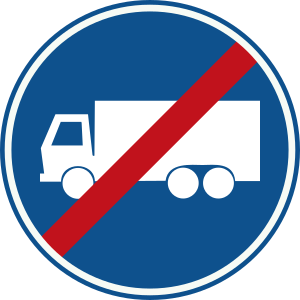 F22: end of carriageway or lane for trucks
Practise this with 2,609 questions and 19 animations
Rijtheorie Hub practises exactly like the CBR exam: 50 questions, 30 minutes, pass with 44. Free to try, in 12 languages.
Download free