
Home › Theory guide › Special Road Types and Their Rules
Special Road Types and Their Rules
Erf (residential yard/woonerf): pedestrians first, 15 km/h max, playing allowed
In an erf you drive at most 15 km/h and pedestrians always come first.
- Blue sign: house, playing child and car
- 15 km/h max (legal limit since 2013)
- Pedestrians may use whole road; playing allowed
- Park only in marked bays with P
- Leaving the erf: give way to all traffic
Watch out: exceptions and pitfalls
- Since 1 January 2013, 15 km/h has been the legal speed limit in an erf (RVV 1990 art. 45); before that the law said 'walking pace' ('stapvoets'). Older books and websites sometimes still say 'walking pace' — learn 15 km/h, and drive even slower near playing children.
- Parking is only allowed in the marked bays; parking outside them (even 'just for a moment') earns a fine and is a common mistake in Amsterdam.
- When exiting an erf you do NOT have priority: you must give way to everyone on the crossing road, including cyclists and pedestrians.
- Children may play on the carriageway; anticipate balls and children darting out, and remember that as the driver you carry heavy liability.
- In Amsterdam (Jordaan, De Pijp) many erven look like ordinary narrow streets - watch for the blue erf sign, the brick paving and the absence of a raised kerb.
Fietsstraat (bicycle street): 'car is a guest'
On a fietsstraat you adapt to the cyclists; the car is a guest.
- Recognisable by red asphalt and 'auto te gast'
- Not a separate category: normal rules apply
- Match the cyclists' pace; do not tailgate
- Cyclists may ride side by side, full lane
- Usually 30 km/h within built-up area
Watch out: exceptions and pitfalls
- 'Auto te gast' is NOT a priority rule: normal priority (e.g. traffic from the right) still applies - the belief that cyclists automatically have priority everywhere here is wrong.
- The speed limit comes from the zone sign (usually 30 km/h), not from the fietsstraat itself.
- Cars are indeed allowed to drive there; a fietsstraat is not closed to motor vehicles unless a separate closure sign says so.
- Amsterdam examples run around the Vondelpark and parts of the Sarphatistraat - expect dense two-way bicycle traffic overtaking you on both sides.
- When overtaking a cyclist keep ample distance (guideline around 1.5 metres); often simply staying behind is the right choice.
Busbaan and busstrook: when you may use them
Buses only, unless a sign allows others (e.g. TAXI); the line decides if you may enter.
- BUS on road surface and/or blue sign
- Busbaan = separate carriageway; busstrook = lane on carriageway
- Others allowed only if sign says so (TAXI)
- Continuous line: never cross it
- Broken line: cross to turn, don't keep driving on it
- Some apply only at certain times (subsign)
Watch out: exceptions and pitfalls
- Continuous line = you may not cross it at all; broken line = only cross briefly to turn off or reach a driveway, not to drive along it.
- Taxis and other vehicles may only enter if a subsign expressly permits it; otherwise it is an offence.
- Cyclists and mopeds are normally not allowed on the busbaan/busstrook, unless expressly indicated.
- In Amsterdam many lanes are combined for bus and tram, and enforcement is often camera-based (fine by number plate) - even a short 'hop on' is recorded.
- Briefly crossing a broken-line busstrook to park is allowed, but standing still or parking on the lane is not.
- Watch the time windows on the subsign: outside the stated rush hours the lane may sometimes be used by everyone.
Tram track and tram rails: priority and driving on the rails
At a junction without signs a tram always goes first, even from the left. If the tram comes from a side road with shark's teeth, it must let you on the priority road go first.
- Tram cannot swerve, long braking distance
- Tram goes first, except with shark's teeth or signs for the tram
- Trams have own white signals (bars/lines)
- Driving on rails in carriageway allowed; never hinder tram
- Separate tram bed or sign: do not drive on
- Stop without platform: let passengers cross
Watch out: exceptions and pitfalls
- Watch trams: a tram too must give way when it comes from a side road with shark's teeth or a give-way sign. Without signs or shark's teeth a tram does go first.
- Tram signals (white bars/lines) apply only to the tram; they are not your stoplight - watch your own traffic light.
- You may drive on rails lying in the carriageway, but a separate tram track (own bed or 'trams only' sign) is forbidden.
- In Amsterdam's centre tram rails are everywhere; trams appear from unexpected directions and slippery wet rails are extra dangerous for motorcycles and cyclists.
- If a tram or bus stops at a stop without a refuge island, you must stop and let crossing passengers go first.
- Never sit still on the rails in a traffic jam; a tram cannot swerve and you would block the entire line.
Autoweg and autosnelweg: the differences
Motorway = separated carriageways and 100 km/h by day; autoweg is often single, also 100 km/h.
- Both ban slow traffic (cyclists, mopeds, pedestrians)
- Motorway: blue sign with overpass, crash barrier, separated lanes
- Motorway: 100 km/h 06-19h, else sign value (120/130)
- Motorway: vehicles under 60 km/h forbidden
- Autoweg: blue sign white car, often single, 100 km/h
- Both: no stopping, turning, reversing, standing still
Watch out: exceptions and pitfalls
- The 100 km/h on the motorway applies in the daytime between 06:00 and 19:00; at night the higher posted limit applies - watch the (sometimes electronic) signs.
- An autoweg often has NO emergency lane and may carry oncoming traffic; overtaking is far riskier and a broken-down car stands close to or on the carriageway.
- Slow vehicles that cannot reach the minimum are prohibited; do not confuse the autoweg (white car symbol) with the autosnelweg (motorway symbol).
- In Amsterdam the A10 ring road is a motorway, but the urban S-routes (s100, s103, ...) are NOT autowegen - they are ordinary city roads of 50 or 70 km/h, even if they feel fast.
- Turning around via the central reservation, reversing or stopping is a serious offence on both roads.
- When towing a trailer or caravan a lower speed limit often applies - do not automatically assume 100.
Spitsstrook (rush-hour lane) and vluchtstrook (emergency lane)
The emergency lane is for emergencies only; use the rush-hour lane only with a green arrow.
- Emergency lane: far right, continuous line, emergencies only
- No driving, overtaking or stopping to call on it
- Breakdown: far right, hazards on, behind barrier, call 112
- Spitsstrook: extra lane, open only when busy
- Green arrow = open, red cross = closed
- When it ends: merge in good time
Watch out: exceptions and pitfalls
- The emergency lane is not for calling, navigating, going to the toilet or resting - only genuine emergencies; misuse earns a fine.
- Green arrow = open, red cross = closed; driving under a red cross is a serious offence.
- If the rush-hour lane is the emergency lane and it is closed, it is a plain emergency lane again - make sure you are no longer driving on it.
- If you break down while the rush-hour lane is open, use the emergency refuges and do not stand still on the running lane.
- In Amsterdam the A10 ring has rush-hour lanes that open and close via overhead matrix signs - look up at the signals, not at the road markings.
- Using the emergency lane in a traffic jam to reach an exit is prohibited, even if everything is standstill - it is a common offence.
- Keep the emergency lane clear for emergency services; they need it to reach an incident quickly.
Want to practise? Try the free questions on traffic rules, with an explanation for every answer.
Signs for this topic
The signs that belong to this chapter, with their meaning:
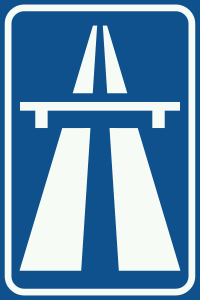 G1: motorway
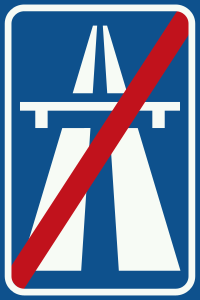 G2: end of motorway
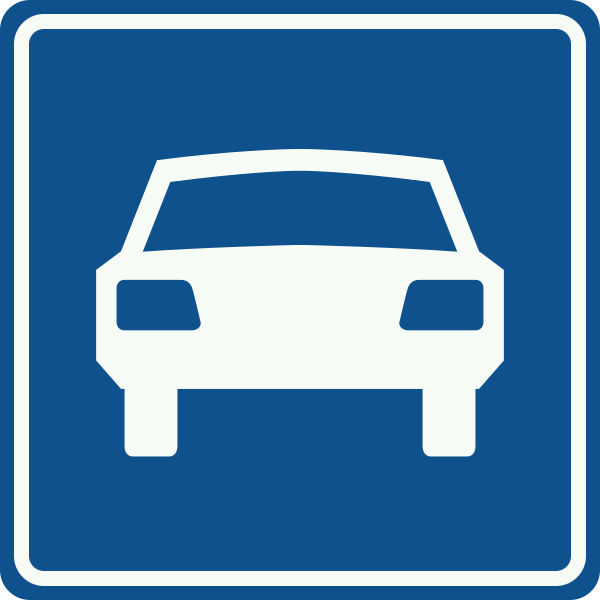 G3: expressway
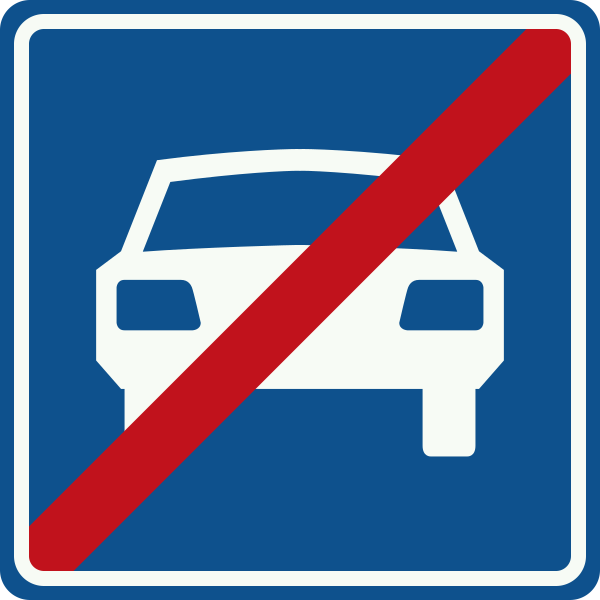 G4: end of expressway
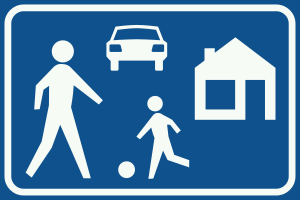 G5: residential zone
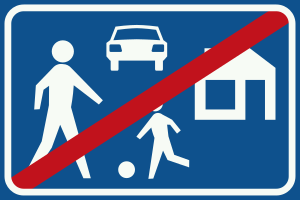 G6: end of residential zone (erf)
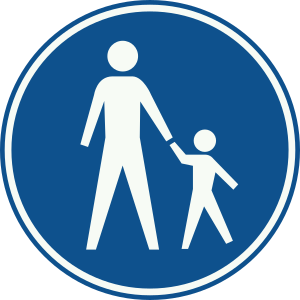 G7: footpath; reserved exclusively for pedestrians
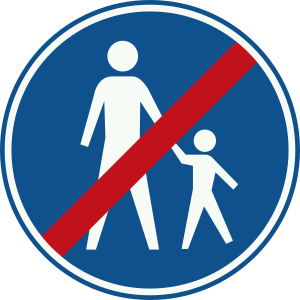 G8: end of footpath
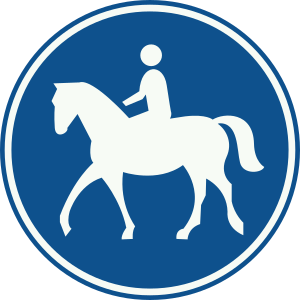 G9: bridleway; reserved exclusively for horses and riders
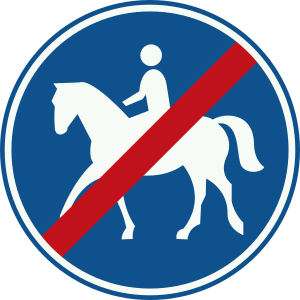 G10: end of bridleway
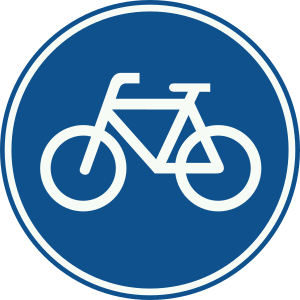 G11: compulsory cycle path
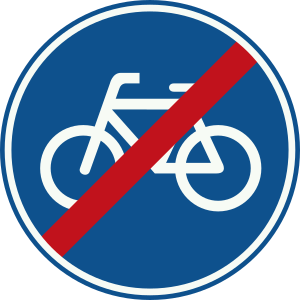 G12: end of compulsory cycle path
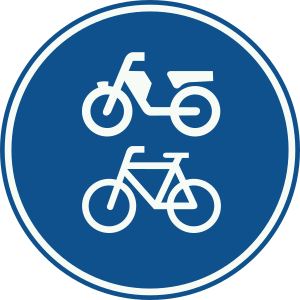 G12a: compulsory cycle/moped path
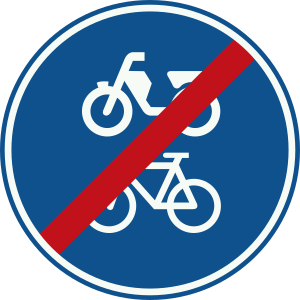 G12b: end of cycle/moped path
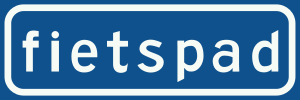 G13: non-compulsory cycle path
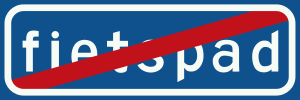 G14: end of non-compulsory cycle path
 H1: built-up area
 H2: end of built-up area
Practise this with 2,609 questions and 19 animations
Rijtheorie Hub practises exactly like the CBR exam: 50 questions, 30 minutes, pass with 44. Free to try, in 12 languages.
Download free