Road type signs: autoweg, motorway, erf (home zone) and their end signs
These signs do not tell you what to do, but what kind of road you are on. And that matters more than it seems: with the road type, the speed limit changes, and so do who may drive there and which manoeuvres are allowed. Below are all 18 signs that start or end a road type.
One sign, a different rulebook
Autoweg and autosnelweg (motorway) are the ones most often confused, and they do not have the same speed or the same rules. In an erf (home zone) even more changes: there the pedestrian has the whole street. The difference between those regimes is worked out in Road types: autoweg, motorway, erf (home zone) and Motorway, lanes and overtaking.
Watch for the end sign
In this category almost every start sign has an end sign. Once you pass the end sign, the road falls back on the standard rules for where you are: inside or outside a built-up area. Miss the end sign and you are working with the wrong speed. That is exactly the mistake the CBR looks for.
All 18 road type signs
Jump to: G1 · G2 · G3 · G4 · G5 · G6 · G7 · G8 · G9 · G10 · G11 · G12 · G13 · G14 · G12a · G12b · H1 · H2
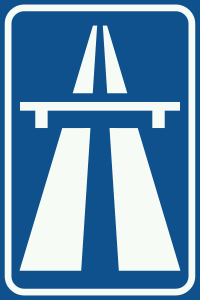
G1 — Motorway; only for motor vehicles able and permitted to drive faster than 60 km/h
Memory hook: The blue sign with the flyover lines: welcome to the motorway, only fast motor vehicles over 60 allowed.
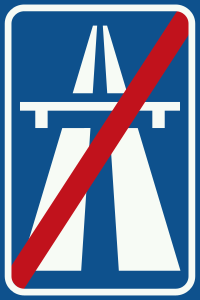
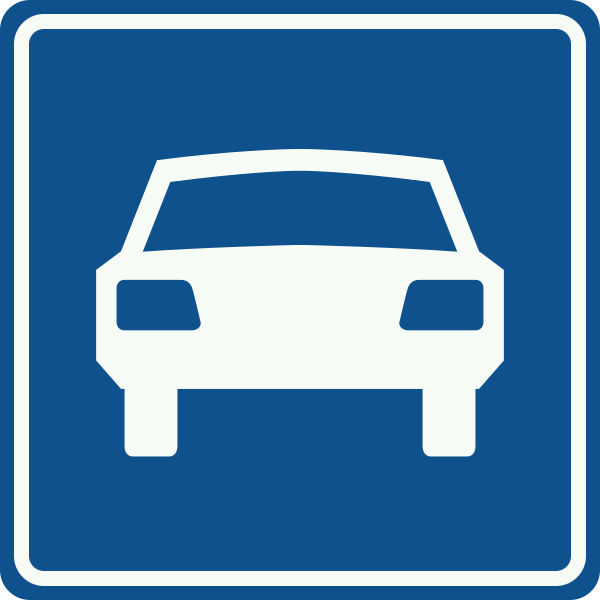
G3 — Expressway (clearway); only for motor vehicles able and permitted to drive faster than 50 km/h
Memory hook: White car on blue: the expressway is the fast club — if you can't do over 50, you don't belong.
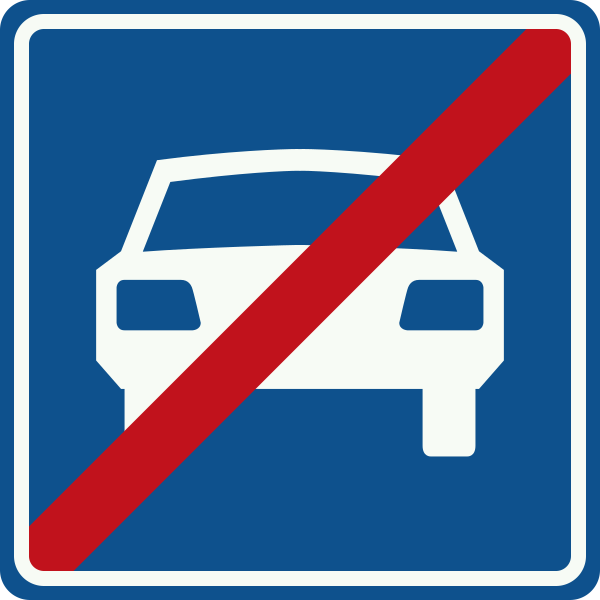
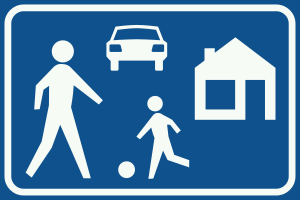
G5 — Residential zone (erf); maximum speed 15 km/h, pedestrians may use the whole road
Memory hook: Little white house with a child playing on blue: welcome to the living zone — tiptoe through at 15 km/h max, the whole street belongs to everyone.
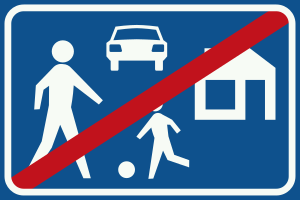
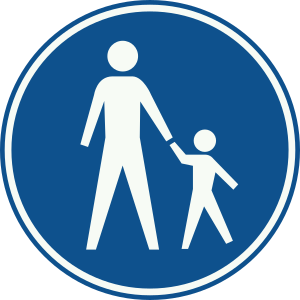
G7 — Footpath; reserved exclusively for pedestrians
Memory hook: The blue sign with a walking figure: this little path is purely for feet, only pedestrians step here.
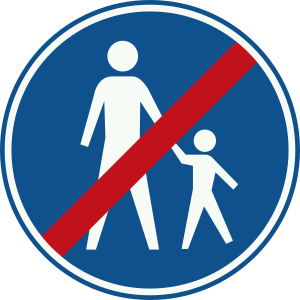
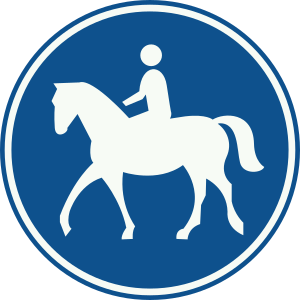
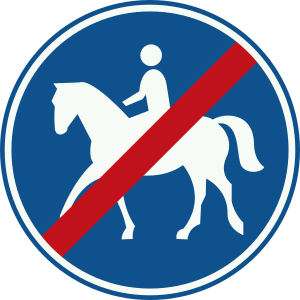
G9 — Bridleway; reserved exclusively for horses and riders
Memory hook: A blue sign with a horse and rider: this path is a gallop track, only hooves may clatter here.
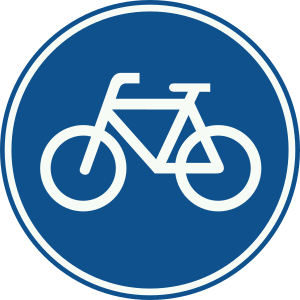
G11 — Compulsory cycle path; for cyclists and mopeds (snorfiets), who are obliged to use it
Memory hook: Round and blue is an order, not an invitation: as a cyclist you belong here and nowhere else.
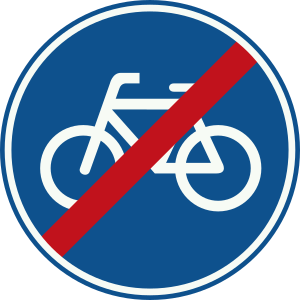
G12 — End of compulsory cycle path
Memory hook: The order is crossed out: the blue circle is gone, you no longer have to stay on the cycle path.
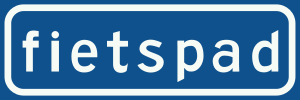
G13 — Non-compulsory cycle path; intended for cyclists and mopeds (snorfiets), but use is not obligatory
Memory hook: No blue circle, just a white sign: an invitation, not an order. 'Come on in' — not 'you must'.
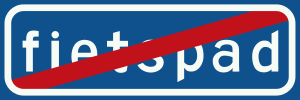
G14 — End of non-compulsory cycle path
Memory hook: The invitation is crossed out: the optional cycle path ends here.
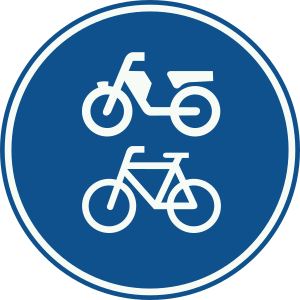
G12a — Compulsory cycle/moped path; for cyclists and mopeds (bromfiets/snorfiets)
Memory hook: Bike and moped in one blue circle: two brothers sharing a bedroom — both have to sleep here.
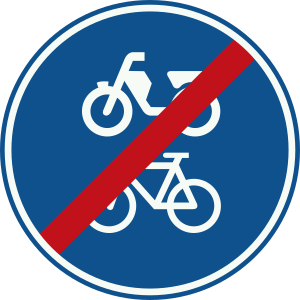
G12b — End of cycle/moped path
Memory hook: Bike and moped together, but the circle is gone: the shared room is closed.
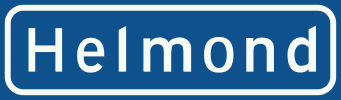
H1 — Built-up area (blue place-name sign; start of the built-up area / town)
Memory hook: A blue sign carrying a place-name: blue means 'welcome to the town' - the built-up area starts right here, so ease off the pedal.
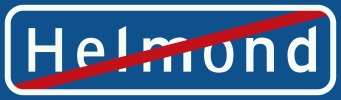
H2 — End of built-up area (place-name sign crossed out in red; end of the built-up area / town)
Memory hook: The place name is crossed out: the town waves you off, your foot can leave the brake.
Further reading
The full sign library with all 202 signs is at all road signs. To see the speeds per road type side by side, read Speed: all limits and exceptions.
Want to practise? Try the free questions on road signs and markings, with an explanation for every answer.
Practise this with 2,609 questions and 19 animations
Rijtheorie Hub practises exactly like the CBR exam: 50 questions, 30 minutes, pass with 44. Free to try, in 12 languages.
Download free