
Types of junctions in the Netherlands: which are there and who goes first?
There are two types of junctions: uncontrolled junctions (gelijkwaardige kruispunten) and junctions that are not equal (ongelijkwaardige kruispunten). At an uncontrolled junction nothing decides the priority and the right goes first. At a junction that is not equal, signs, give-way lines (haaientanden) or traffic lights decide who may go first.
What is a junction?
A junction is every place where roads cross each other or where a road forks. So a T-junction is a junction too, just like a roundabout. The ANWB describes a junction as a node where roads come together and split.
Difference between the Dutch words kruising and kruispunt
What is a kruising? In the law, kruising (crossing) is the wider word: the place where two things cross each other. A crossing of roads is a junction (kruispunt). But a crossing of a road and a railway is called a level crossing (overweg) (Article 1), and that is not a junction. In everyday use and in theory questions, kruising and kruispunt usually mean the same. T kruising is another word for T-splitsing (T-junction).
The types of junctions by priority
| Type | How to recognise it | Who goes first |
|---|---|---|
| Uncontrolled junction | No signs, give-way lines or traffic lights | Drivers from the right (Article 15) |
| Priority junction (voorrangskruispunt) or priority road (voorrangsweg) | Sign B3, B4, B5 or B1 for you; sign B6, B7 or give-way lines for the other | Drivers on the priority road |
| Junction with traffic lights | Working traffic lights | The light decides: traffic lights go before signs that decide the priority (Article 64) |
| Paved and unpaved road | Asphalt or bricks opposite a sand track | Drivers on the paved road (Article 15, paragraph 2) |
The rules for each type are explained in full in priority at an uncontrolled junction, priority road and unpaved road and priority.
Different junctions by shape
The ANWB names these as the most common shapes:
- T-junction or Y-junction: a junction with three arms. See priority at a T-junction.
- Four-arm junction (viertakskruispunt, viersprong): a junction with four arms, at right angles like a plus or slanted like an X.
- Roundabout: the round junction. Priority there is usually decided with signs and give-way lines; if those are missing, the right goes first.
- Staggered junction (bajonetkruispunt): two T-junctions a short distance apart, opposite each other.
- Priority square (voorrangsplein): a mix of a roundabout and a priority junction with a main flow that goes first.
The shape does not change the priority rule. According to the ANWB the basic rule at every junction is that traffic from the right goes first, unless signs and markings show something else or the traffic from the right comes from an unpaved road or out of an exit (uitrit).
What is a crossing road and what is crossing traffic?
The crossing road (kruisende weg) is the road that crosses your road at the junction. Crossing traffic (kruisend verkeer) is the traffic that comes along that road from the left or right. The word is in the meaning of sign B6 and of give-way lines: give way to drivers on the crossing road (Annex 1 and Article 80). You then wait for drivers from the left and from the right.
Junction sign: which signs belong to it?
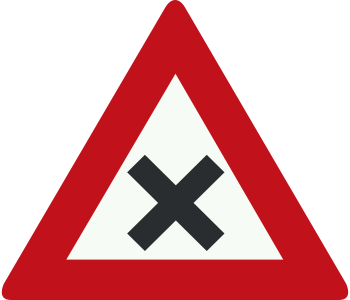
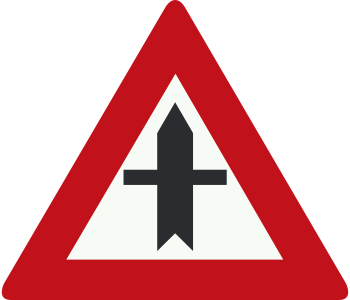
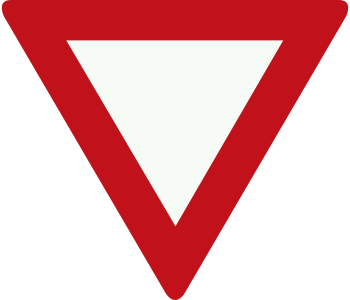
- J8: dangerous junction. This road sign warns, but does not decide the priority.
- B3, B4 and B5: priority junction. You have priority at the next junction.
- B6 and B7: give way to drivers on the crossing road; at B7 you stop first.
- J9: warning for a roundabout.
All signs are in the overview of priority signs.
At-grade and grade-separated junctions
The Dutch words for these, gelijkvloerse kruising and ongelijkvloerse kruising, are not in the RVV 1990. Gelijkvloers literally means: at the same height. At an at-grade junction the roads meet at the same level and the priority has to be decided. At a grade-separated junction one road goes over or under the other with a viaduct or tunnel. The traffic then does not cross.
Rules that apply at every junction
- You may not block a junction (Article 14).
- You may not stop on a junction (Article 23) and not park within five metres of a junction (Article 24).
- If you turn, you let traffic go first that continues straight on along the same road (Article 18).
Practise the situations in the right-of-way quiz with animations.
Frequently asked questions
How many types of junctions are there?
Two main types: uncontrolled junctions, where the right goes first, and junctions that are not equal, where signs, give-way lines or traffic lights decide the priority. Within these there are different shapes, such as the T-junction, the four-arm junction and the roundabout.
What is a junction?
A crossing or fork of roads (Article 1 of the RVV 1990).
What is the difference between a kruising and a kruispunt?
A kruispunt (junction) is a crossing or fork of roads. Kruising (crossing) is wider: the crossing of a road and a railway is a level crossing and not a junction. In everyday use the two words are used for the same thing.
What is a crossing road?
The road that crosses your road at the junction. At sign B6, sign B7 and give-way lines you give way to drivers on the crossing road, from the left and from the right.
Which road sign warns of a junction?
Sign J8: dangerous junction. Signs B3, B4 and B5 show a priority junction.
What is a grade-separated junction?
A crossing where the roads are not at the same height: one road goes over or under the other with a viaduct or tunnel, so that the traffic does not cross.
Want to practise? Try the free questions on right of way, with an explanation for every answer.
Practise this with 2,606 questions and 19 animations
Rijtheorie Hub practises exactly like the CBR exam: 50 questions, 30 minutes, pass with 44. Free to try, in 12 languages.
Download free Get it on Google Play