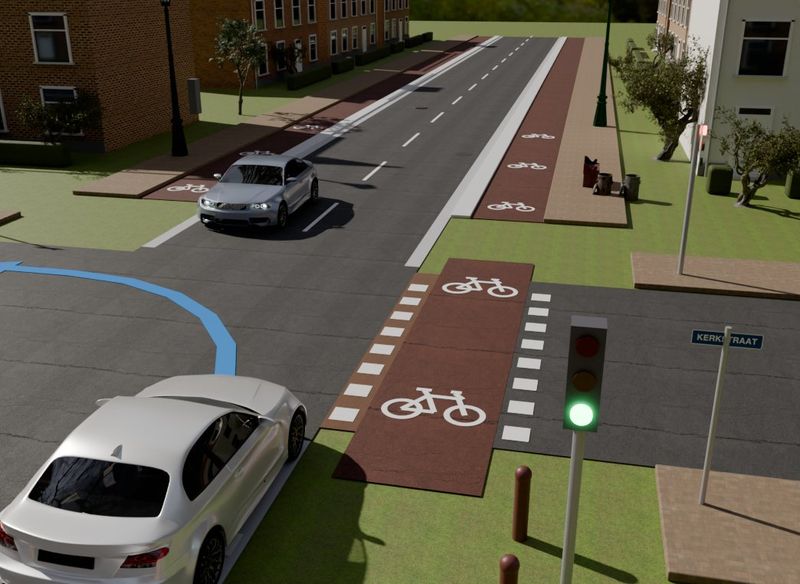
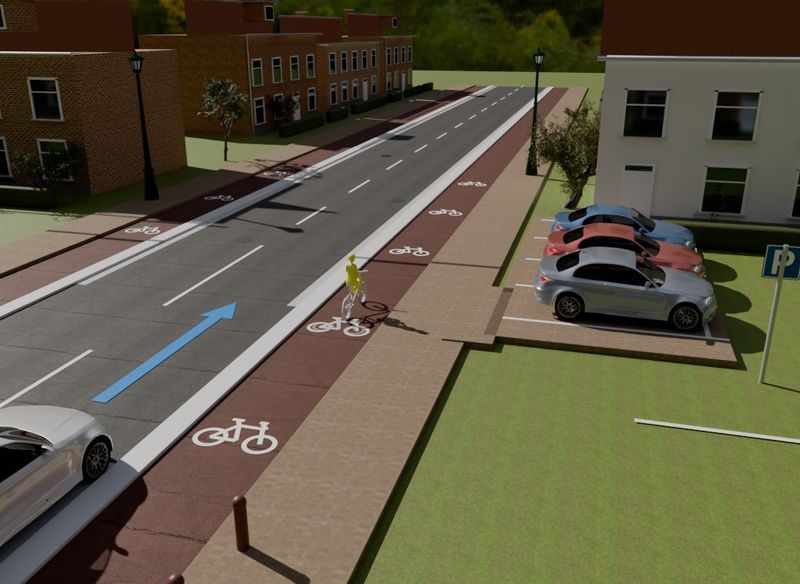
10 free practice questions on right of way for the Dutch CBR car theory exam. Who goes first: at uncontrolled junctions, at give-way lines and stop signs, on roundabouts and with trams, buses and emergency vehicles. After every answer you see the explanation and the source. The app has 376 questions on this topic.
What you need to know
At an equal intersection with no signs or markings, right always goes first.
Shark's teeth mean give way without stopping; a stop sign requires a full standstill.
Whoever turns off always waits for straight-ahead and oncoming traffic, even on a priority road.
During a special manoeuvre or from a driveway you give way to everyone, including from the left.
A priority vehicle only has priority with both the blue flashing light AND the siren.
A tram almost always goes first, even from the left; at a level crossing the train always has priority.
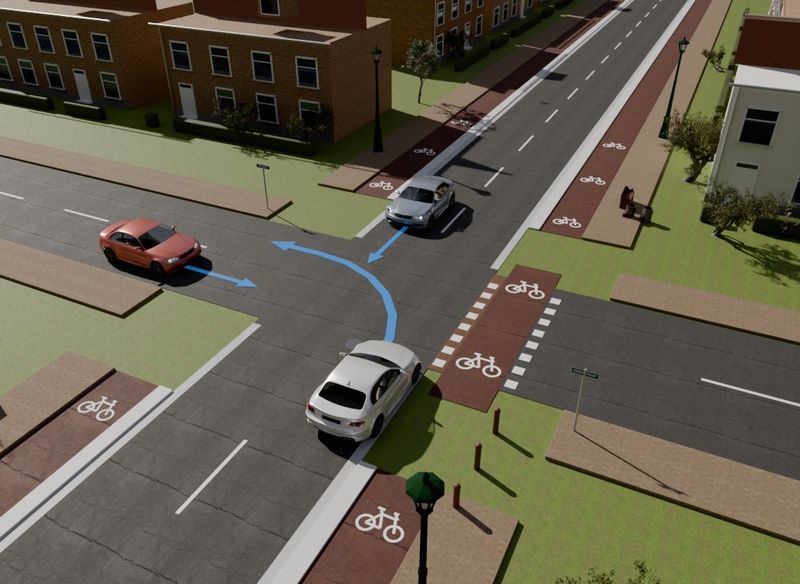
1. At an equal crossroads you want to turn left. From the left comes a car that is going straight on. Must you let this car go first because you are turning?
Show in Dutch
Op een gelijkwaardig kruispunt wil je linksaf. Van links komt een auto die rechtdoor gaat. Moet je deze auto voor laten gaan omdat jij afslaat?
Explanation: No. The turning rule (art. 18(1)) concerns traffic coming towards you on the same road or driving beside or close behind you, not traffic on the crossing road. For the car from the left, 'right goes first' simply applies (art. 15(1)): you come from its right, so it must let you go first. Do check that it actually does.NL: NeeSource: RVV 1990 art. 15 lid 1; RVV 1990 art. 18 lid 1
2. Equal crossroads without signs. You want to turn left. An oncoming car is going straight on and a car from the left is also going straight on; all three of you arrive at the same time. May you go first, because the car from the left has to let you go first as the driver coming from the right?
Show in Dutch
Gelijkwaardig kruispunt zonder borden. Jij wilt linksaf. Een tegemoetkomende auto gaat rechtdoor en een auto van links gaat ook rechtdoor; jullie komen alle drie tegelijk aan. Mag jij als eerste, omdat de auto van links jou als bestuurder van rechts moet voor laten gaan?
Explanation: No. You are turning, so you must let the oncoming car going straight on go first (art. 18(1)). That car in turn must let the car from the left go first, because for it that car comes from the right, and that car must let you go first (art. 15(1)). This creates a circle in which nobody has priority; one driver has to give up his priority and make that clear.NL: NeeSource: RVV 1990 art. 18 lid 1; RVV 1990 art. 15 lid 1
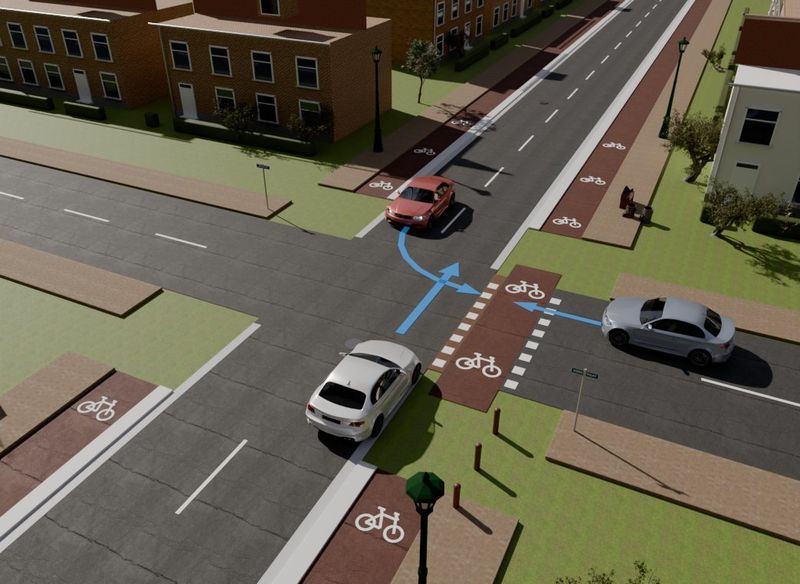
3. Equal crossroads without signs. You are going straight on. At the same moment as you, a car on your right, also going straight on, and the car opposite you, which is turning left, arrive at the junction. Who may enter the junction first?
Show in Dutch
Gelijkwaardig kruispunt zonder borden. Jij gaat rechtdoor. Tegelijk met jou komen een auto aan je rechterhand, die ook rechtdoor gaat, en de auto tegenover je, die naar links afslaat, bij het kruispunt aan. Wie mag als eerste het kruispunt op?
Explanation: You must let the car on your right go first (art. 15(1)); that car must let the car opposite you go first, because for it that car comes from the right (art. 15(1)); and the turning car opposite you must let you, oncoming traffic going straight on, go first (art. 18(1)). So everyone is waiting for someone: the law appoints nobody, which is why one driver has to give up his priority and make that clear.NL: Niemand heeft hier voorrang: één van de bestuurders moet zijn voorrang afstaan, bijvoorbeeld met een handgebaarSource: RVV 1990 art. 15 lid 1; RVV 1990 art. 18 lid 1
4. In a car park you are reversing out of your bay. From the right a pedestrian approaches along the pavement and wants to walk behind you. Must you let this pedestrian go first, even though he is not a driver?
Show in Dutch
Je rijdt op een parkeerterrein achteruit uit je parkeervak. Van rechts nadert over het trottoir een voetganger die achter je langs wil lopen. Moet je deze voetganger voor laten gaan, ook al is hij geen bestuurder?
Explanation: Yes. Reversing is a special manoeuvre, and then you must let all other traffic go first (art. 54). 'Traffic' means all road users (art. 1), so pedestrians too. That the pedestrian is not a driver makes no difference here.NL: JaSource: RVV 1990 art. 54; RVV 1990 art. 1
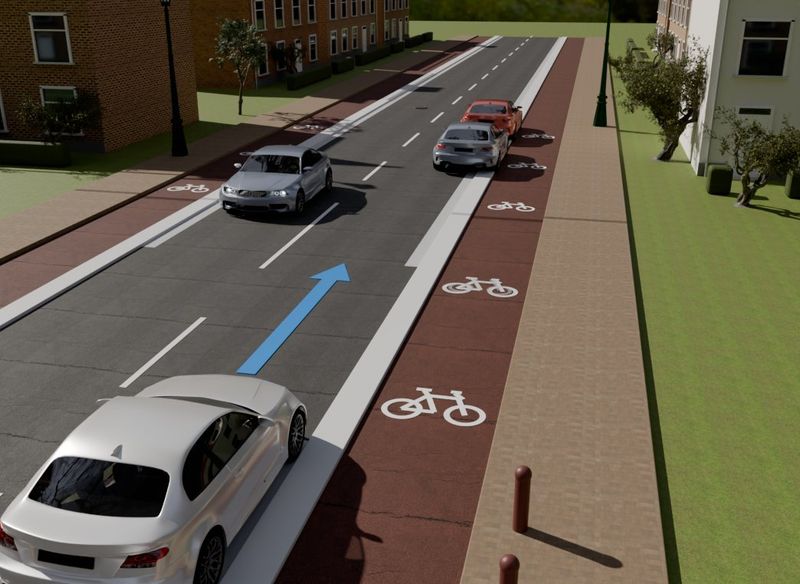
5. Inside the built-up area cars are parked on your side of a narrow street. To pass them you have to use the other half of the road. An oncoming car is approaching and there are no signs. What do you do?
Show in Dutch
Binnen de bebouwde kom staan aan jouw kant van een smalle straat auto's geparkeerd. Om erlangs te rijden moet je over de andere weghelft. Er komt een tegenligger aan en er staan geen borden. Wat doe je?
Explanation: The obstacle is on your half of the road. You must keep as far right as possible (art. 3) and may not hinder or endanger the oncoming car (WVW art. 5). Without F5/F6 signs there is no formal priority rule, but in practice the driver on whose side the obstacle is waits. Being there first or indicating gives you no priority.NL: Je wacht vóór de geparkeerde auto's tot de tegenligger voorbij isSource: WVW 1994 art. 5; RVV 1990 art. 3
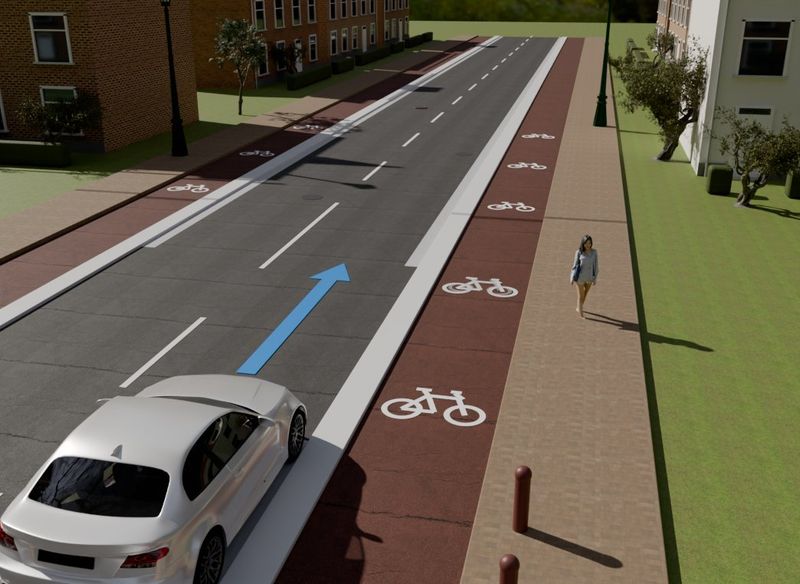
6. You are driving on a straight street inside the built-up area. On the pavement on the right stands a pedestrian who clearly wants to cross. There is no zebra crossing here. Are you obliged to let him go first?
Show in Dutch
Je rijdt binnen de bebouwde kom op een rechte straat. Rechts op de stoep staat een voetganger die duidelijk wil oversteken. Er is hier geen zebrapad. Ben je verplicht hem voor te laten gaan?
Explanation: No. The duty to let pedestrians go first who are crossing or clearly about to cross applies only at a pedestrian crossing (art. 49(2)). Without a zebra crossing the pedestrian has no priority and must wait until the road is clear. Of course you may never endanger him (WVW art. 5), so stay alert.NL: NeeSource: RVV 1990 art. 49 lid 2; WVW 1994 art. 5
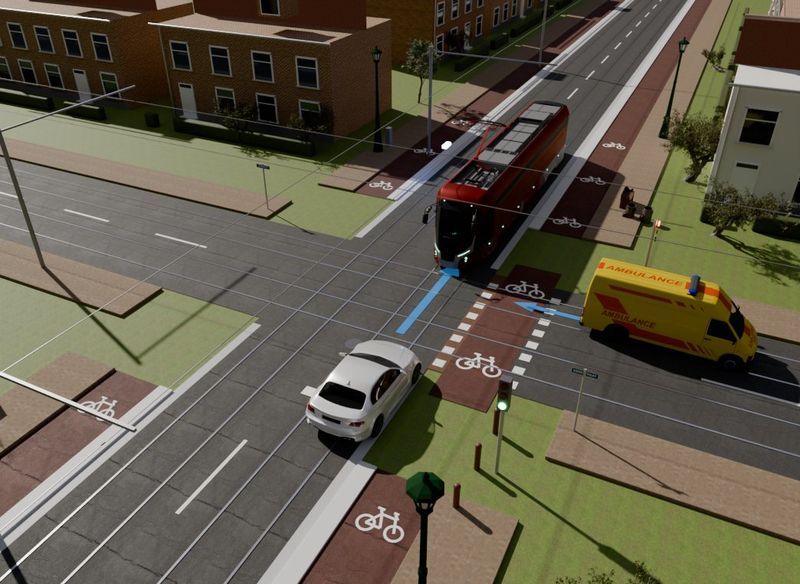
7. Signalised crossroads; you have green. Just ahead of you a tram is driving in the same direction and may also proceed. From the right an ambulance with blue flashing light and siren approaches through red. Who must let the ambulance go first?
Show in Dutch
Kruispunt met verkeerslichten; jij hebt groen. Vlak voor je rijdt in dezelfde richting een tram, die ook mag doorrijden. Van rechts nadert door rood een ambulance met blauw zwaailicht en sirene. Wie moet de ambulance voor laten gaan?
Explanation: Road users must let a priority vehicle go first (art. 50); that applies to everyone, so also to the tram driver. Green only means 'proceed' (art. 68(1)) and gives no priority over an ambulance with blue light and siren. The tram's special position applies to 'right goes first', not against a priority vehicle.NL: Zowel de tram als jij: een voorrangsvoertuig gaat voor alle weggebruikers, ook bij groen lichtSource: RVV 1990 art. 50; RVV 1990 art. 68 lid 1
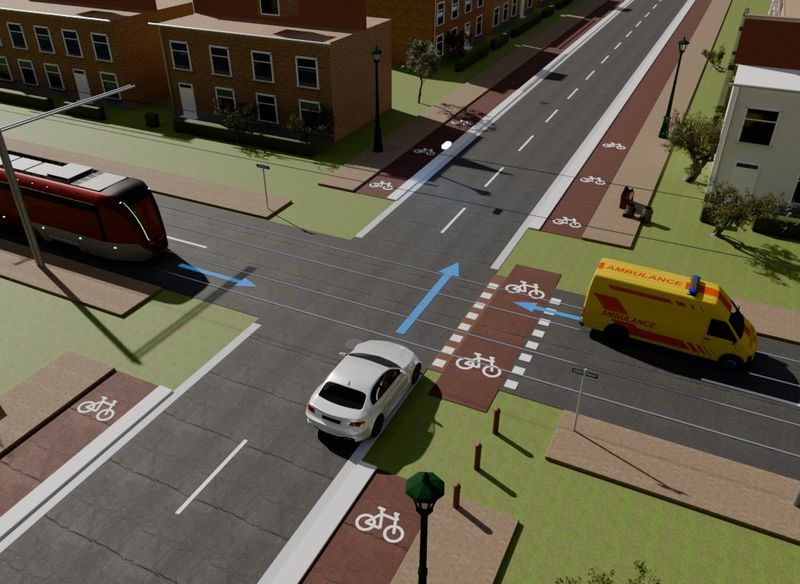
8. Equal crossroads without signs. A tram approaches from the left, an ambulance with blue flashing light and siren from the right. What is the correct order?
Show in Dutch
Gelijkwaardig kruispunt zonder borden. Van links nadert een tram, van rechts een ambulance met blauw zwaailicht en sirene. Wat is de juiste volgorde?
Explanation: All road users, including the tram driver, must let a priority vehicle go first (art. 50): the ambulance goes first. After that the exception to 'right goes first' applies: drivers give way to a tram (art. 15(2)), even when it comes from the left. So you go last.NL: Eerst de ambulance, dan de tram, dan jijSource: RVV 1990 art. 50; RVV 1990 art. 15 lid 2
9. You are waiting at a signalised crossroads and want to turn left. Your light turns green, without a separate arrow. The oncoming cars also have green and are going straight on. What do you do?
Show in Dutch
Je staat voor een kruispunt met verkeerslichten en wilt linksaf. Je licht wordt groen, zonder aparte pijl. De tegenliggers hebben ook groen en gaan rechtdoor. Wat doe je?
Explanation: A green light only means 'proceed' (art. 68(1)) and changes nothing about the turning rule: drivers who turn must let oncoming traffic on the same road go first (art. 18(1)). Without a green arrow for turning left the oncoming cars also have green and they go first. An oncoming car slowing down is no guarantee that it is letting you go first.NL: Je laat de rechtdoorgaande tegenliggers voorgaan: groen licht geeft geen voorrang op tegemoetkomend verkeerSource: RVV 1990 art. 18 lid 1; RVV 1990 art. 68 lid 1
10. You want to turn right into the entrance of a car park. To do so you have to cross the cycle path. From behind a cyclist approaches on that cycle path. What do you do?
Show in Dutch
Je wilt rechtsaf de inrit van een parkeerterrein oprijden. Daarvoor moet je het fietspad kruisen. Van achteren nadert op dat fietspad een fietser. Wat doe je?
Explanation: Driving from a road into an entrance is a special manoeuvre: you must let all other traffic go first (art. 54). Moreover you are turning and must let traffic close behind you on the right on the same road, such as this cyclist on the cycle path, go first (art. 18(1)). Indicating or sounding the horn gives no priority.NL: Je laat de fietser voorgaan en rijdt daarna de inrit opSource: RVV 1990 art. 54; RVV 1990 art. 18 lid 1
Memory hooks for this topic
👉🚗🥇🛑At equal-priority intersections, traffic coming from the right has priority.
RIGHT is ROYALTY: the car on your right wears a golden crown, so you bow and brake. Rhyme it: 'Right goes, left waits!'
🚊👑⚡🛑Exception: the tram usually has priority — even when it comes from the left.
The tram is the KING who ignores the right-hand rule: far too heavy to brake, so even from the left it thunders straight through. Bow to the tram-king!
🔄🚗🥇⏳On a roundabout, traffic already on the ring has priority; you wait before entering.
The roundabout is a MERRY-GO-ROUND: whoever's already spinning keeps spinning — you only hop on when a gap opens up.
🚌🏙️🖐️🥇Within a built-up area you must give way to a bus pulling out from a stop.
In TOWN the bus is boss: blinker on at the stop and your foot hits the brake. Inside the built-up area you yield — outside town you don't!