
Home › Theory guide › Priority (Right of Way): the full system and every exception
Priority (Right of Way): the full system and every exception
Equal (uncontrolled) intersections: the vehicle from the right goes first
At an equal intersection with no signs or markings, right always goes first.
- No signs, shark's teeth, lights or priority road = equal
- Traffic from the right has priority (Article 15 RVV 1990)
- Applies to cars, motorcycles, mopeds and cyclists
- Road width or busyness does not matter
- Priority must be given, never taken
- Amsterdam grids: nearly every junction equal, scan right
Watch out: exceptions and pitfalls
- Cyclists and scooters/mopeds coming from the right ALSO have priority — this is by far the most common mistake in Amsterdam.
- A wider, busier or 'more important-looking' road gives NO priority if there are no signs or markings; the shape of the road does not count.
- The right-hand rule applies ONLY at equal intersections — the moment there are shark's teeth, signs, traffic lights or a priority road, it no longer applies.
- Giving way ≠ taking way: if you have priority but the other driver does not stop, you must still brake to avoid a collision (liability is a separate matter).
- At a T-junction the right-hand rule ALSO applies unless otherwise indicated; the through (straight) road has NO automatic priority.
Priority road, shark's teeth and the stop sign
Shark's teeth mean give way without stopping; a stop sign requires a full standstill.
- Priority road: yellow-orange diamond with white border
- Shark's teeth = give way, you may keep rolling
- Stop sign (red octagon): full standstill at the line
- Stopping required even if nothing is coming
- Hierarchy: lights/officer over signs over road markings
Watch out: exceptions and pitfalls
- Shark's teeth = give way (you may keep rolling); stop sign with stop line = full standstill, EVEN if the junction is empty.
- The points of the shark's teeth aim at YOU → then YOU must give way.
- On a priority road you have priority over crossing traffic, but turning is still turning: you must still let oncoming traffic AND cyclists on the adjacent cycle path go first.
- End of priority road (diamond with a black bar): from there the ordinary rules apply again, so possibly 'right-hand rule'.
- Hierarchy when signals conflict: traffic controller > traffic light > sign > road marking.
- A flashing amber traffic light does NOT mean you have priority — the light is out of service, so fall back on the signs and markings on the spot.
Turning off: give way to straight-ahead and oncoming traffic
Whoever turns off always waits for straight-ahead and oncoming traffic, even on a priority road.
- Turning off = give way (Article 18 RVV 1990)
- Left turn: let all oncoming traffic and the tram go
- Right turn: let straight-on cyclists and mopeds go
- Blind-spot: classic Amsterdam danger
- Applies even when you are on the priority road
- Indicate early and glance over your shoulder
Watch out: exceptions and pitfalls
- Straight-ahead goes BEFORE turning on the same road — EVEN if you are both on the priority road.
- Turning right: cyclists and mopeds going straight on the cycle path beside you have priority (blind-spot collisions are the danger here).
- Turning left: besides oncoming cars, you also let oncoming cyclists, mopeds AND the tram go first.
- Two cars opposite each other both turning left: in practice you usually pass in front of each other (around each other), but this is not a hard priority rule — look carefully and communicate.
- If you turn into a driveway or an 'erf', it is not an ordinary turn but a 'special manoeuvre': then you must let ALL traffic go first.
- You must always let pedestrians cross a zebra crossing you are turning towards.
Exceptions to the right-hand rule: driveways, the 'erf', unpaved roads and pulling away
During a special manoeuvre or from a driveway you give way to everyone, including from the left.
- Special manoeuvre (Article 54): yield to all, even left
- Applies to driveway, erf, pulling away, turning, reversing
- Unpaved road gives way to a paved road
- Driveway: raised pavement/cycle path across = no priority
- Equal side road: normal right-hand rule applies
Watch out: exceptions and pitfalls
- Coming out of a driveway or off an 'erf': you give way to everyone, INCLUDING traffic from the left and pedestrians/cyclists on the footway you cross.
- Recognizing driveway vs junction: does the pavement/cycle path run raised and in the same paving across the side road? Then it is a driveway → you have NO priority.
- An unpaved road (sand/gravel) gives way to the paved road, regardless of left or right.
- Pulling away from the kerb, turning around and reversing are special manoeuvres: always let all traffic go first.
- Leaving a car park, petrol/fuel station or parking lot counts as a driveway in Amsterdam — everyone goes before you.
- On a woonerf (residential yard-street) you may drive no faster than 15 km/h and pedestrians (who may also walk on the carriageway) weigh extra heavily.
Priority vehicles and the bus pulling away from a stop
A priority vehicle only has priority with both the blue flashing light AND the siren.
- Priority only with blue flashing light AND siren (Article 50)
- Blue light alone = no priority, normal rules apply
- Make room: move right, slow down or stop
- May cross a red light only if it is safe
- Built-up area: let a departing line bus merge (Article 43)
- Outside the built-up area the bus has no priority
Watch out: exceptions and pitfalls
- Only when it shows BOTH the blue flashing light AND the siren at the same time is it a priority vehicle; a flashing light alone = NO priority.
- Making room is allowed, but not dangerously: running a red light or crossing a stop line to make room only if it can be done safely — otherwise wait.
- The bus priority applies ONLY inside the built-up area, and only if the bus indicates AND actually pulls away from the stop.
- Outside the built-up area the departing bus has NO priority — then normal 'who went first' applies.
- You remain responsible for your own manoeuvre; swerving blindly and causing a collision is on you.
- In Amsterdam trams and buses often pull away abruptly at stops — even if you formally have priority, anticipate and keep your distance.
Trams (almost always priority) and level crossings
A tram almost always goes first, even from the left; at a level crossing the train always has priority.
- Tram goes first, from left and right (Article 15 RVV 1990)
- The right-hand rule does not protect you against a tram
- Exception: tram facing shark's teeth, sign or red tram signal
- Separate tram signals: bar = stop, triangle/dot = go
- Keep rails clear, never stop on them, not even in a queue
- Level crossing (St Andrew's cross): train always first, no red-light entry
Watch out: exceptions and pitfalls
- A tram from the left AND from the right goes first: the right-hand rule does not apply against a tram.
- Exception: if the tram itself faces shark's teeth, a priority sign or a red tram signal, the tram gives way — in Amsterdam this really does occur.
- Never come to a stop on the tram lane or tram rails, not even in a queue; always keep the rails and the crossing clear.
- Look separately at the dedicated tram signals (white figures) — they are independent of the ordinary traffic lights and can indicate something different.
- Level crossing: flashing red, ringing bells or lowering barriers = stop, even if you cannot see a train yet.
- A single St Andrew's cross = one track; a double St Andrew's cross = multiple tracks (a second train may come from the other direction — wait for a clear view).
- Amsterdam tram junctions often combine tram, bike AND car in one spot; untangle the signals calmly and do not blindly follow the car in front of you.
Want to practise? Try the free questions on right of way, with an explanation for every answer.
Signs for this topic
The signs that belong to this chapter, with their meaning:
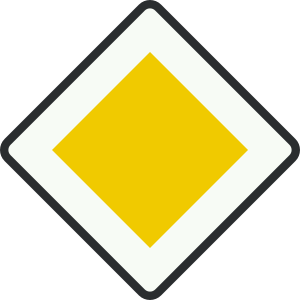 B1: priority road
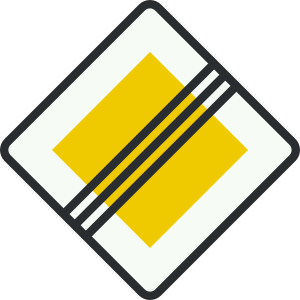 B2: end of priority road
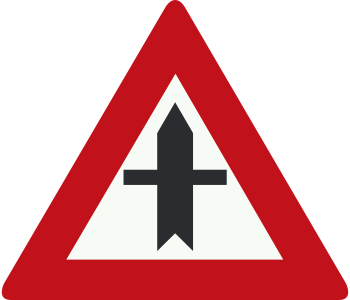 B3: priority crossroads
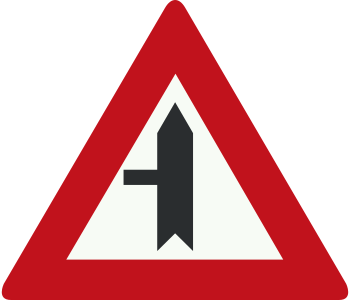 B4: priority intersection, side road to the left
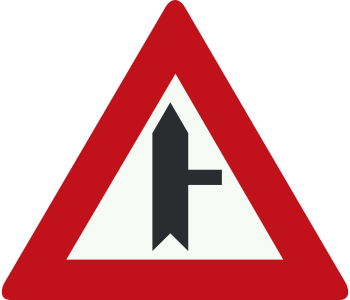 B5: priority intersection, side road to the right
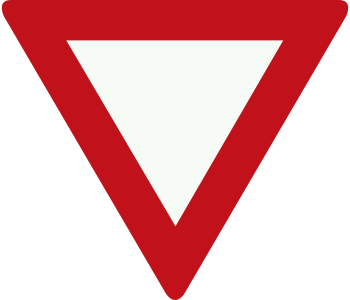 B6: give way to drivers on the intersecting road
 B7: stop; give way to drivers on the intersecting road
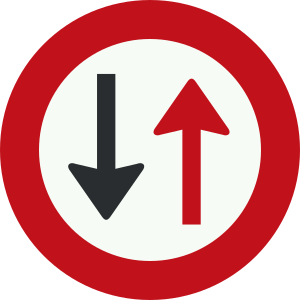 F5: drivers must give way to oncoming traffic
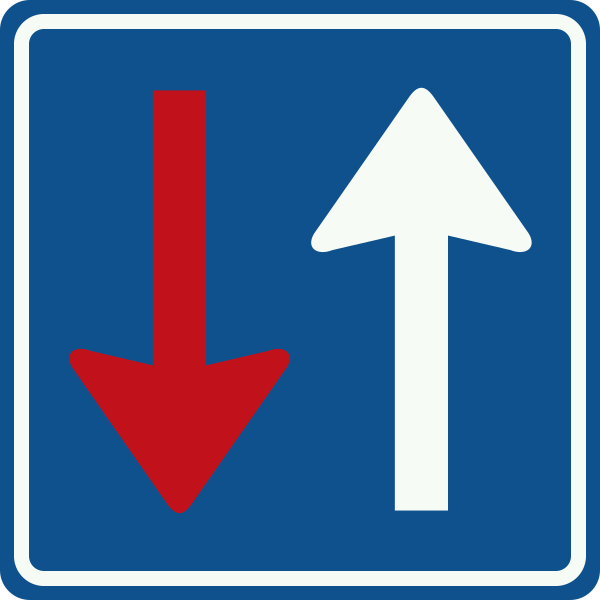 F6: priority over oncoming traffic
Practise this with 2,609 questions and 19 animations
Rijtheorie Hub practises exactly like the CBR exam: 50 questions, 30 minutes, pass with 44. Free to try, in 12 languages.
Download free