
Home › Theory guide › Speed limits and every exception
Speed limits and every exception
Within the built-up area: 50 km/h and Amsterdam's 30 zones
Inside the built-up area the default is 50 km/h, but mostly 30 in Amsterdam.
- Default max inside built-up area: 50 km/h
- Blue-white place-name sign defines the zone, not houses
- Since Dec 2023: 30 km/h on most streets inside A10
- Through-routes and canals often stay at 50
- Zone board applies until 'end of zone' sign
- Round red-rimmed sign: only until next intersection
Watch out: exceptions and pitfalls
- The place-name sign on a blue background marks the built-up area; a white sign with the same name is only a district/neighbourhood indicator and does not change your speed limit.
- In Amsterdam 30 is now the rule and 50 the exception inside the Ring: do not assume an 'ordinary' street is 50 — check the signs and the road picture (asphalt colour, humps, narrow lane).
- A 30 zone applies to the entire zone, including side streets with no sign of their own; many fines happen because people think the 30 has ended after a side street.
- Around many Amsterdam canals and on narrow two-way streets with parked cars, even 30 is often too fast for the situation — the signed limit is a maximum, not advice.
- Trams almost always have priority in Amsterdam and run at their own speed; adjust to tram rails, because braking on wet rails takes extra distance.
Outside the built-up area and on the autoweg: 80 and 100 km/h
Outside the built-up area the default is 80 km/h; on an autoweg 100 km/h.
- Place-name sign with red stripe: built-up area ends
- Ordinary roads outside built-up area: default 80 km/h
- N-roads stay 80 even though they feel open
- Autoweg (blue sign with white car): default 100 km/h
- Autoweg is not a motorway: watch crossings and lights
- No sign? Fall back on 80 outside built-up area
Watch out: exceptions and pitfalls
- Outside the built-up area 80 is the default, not 100: many drivers go too fast on N-roads because they expect an autoweg that isn't there.
- An autoweg is not the same as a motorway — its sign shows a car (autoweg), not a bridge/overpass symbol (motorway); the limit and the rules differ.
- On an autoweg slow vehicles (such as agricultural traffic) may sometimes still use the road when there is no parallel road; expect unexpectedly slow traffic.
- Around Amsterdam some stretches such as parts of the S-roads and access roads are 70; the road looks like an autoweg but the signs say otherwise — read the sign.
- Immediately after an exit or junction a new, lower limit may apply; the old 100 or 80 ends the moment you pass a new sign.
On the motorway: 130, 120 and 100 km/h during the day
During the day (06:00-19:00) almost every motorway is limited to 100 km/h.
- Legal motorway maximum: 130 km/h
- Since March 2020: 100 km/h by day (06:00-19:00)
- At night (19:00-06:00): often 120 or 130
- Times printed on the sign: read the subtitle
- No time window? Value applies all day
- Around Amsterdam (A10, A1, A2, A4, A9): 100 by day
Watch out: exceptions and pitfalls
- The time window (06:00–19:00) is on the sign; don't rely on memory, read the subtitle, because not every stretch has the same evening maximum.
- The 100 daytime limit does not apply everywhere: on a few stretches a different number is signed even by day — the sign always beats the national rule of thumb.
- On the A10 Ring around Amsterdam limits change quickly per segment and there are many matrix signs; these can lower the 100 to 90, 70 or 50 at any moment.
- Just before 19:00 you may only accelerate once the clock has actually passed 19:00 and the signs show a higher evening limit — speeding up too early is a fine.
- Trucks and cars with a trailer are not covered by 130/120: on the motorway they have their own, lower maximum (see the trailer section).
Matrix signs, variable limits and roadworks
Matrix signs and yellow roadworks signs always override fixed signs.
- Matrix sign instantly overrides all fixed signs
- Each matrix sign applies to the lane below it
- Red cross: lane closed, leave it at once
- Flashing yellow arrows: move to another lane
- Yellow roadworks signs beat white signs (90, 70, 50)
- Average-speed cameras often enforce the works limit
Watch out: exceptions and pitfalls
- Matrix sign beats fixed sign: the electronic number always wins, even when it is lower than what a roadside post shows.
- A matrix sign applies per lane — if you change lanes a different (higher or lower) limit may apply; look above the lane you are actually in.
- A red cross is not advice: driving on under a red cross is a serious offence and life-threatening at a breakdown or crash closure.
- Yellow roadworks signs fully replace the white signs; the temporary, lower limit often applies at night too, even when no one is working.
- Average-speed control measures your mean over a long section, so briefly 'overtaking and dropping back' doesn't help — one burst of speed raises your average.
- When a matrix sign goes dark (no number), you revert to the last valid fixed limit; don't automatically go back to the old high speed without a confirming sign.
Trailers, woonerf, school zones and speed in poor visibility
With a trailer lower maxima apply; on a woonerf you drive at most 15 km/h.
- Trailer: 50 built-up, 80 outside, 90 on auto(snel)weg
- Never 100, 120 or 130 with a trailer
- Woonerf: 15 km/h max (legal limit)
- Woonerf: pedestrians everywhere, park only in bays
- School zones: no separate limit, usually in a 30 zone
- Visibility seriously reduced (rule of thumb < 200 m): front fog lights allowed; drive so you can stop within what you can see
Watch out: exceptions and pitfalls
- Car with trailer/caravan: on the motorway not 130 or 120 but 90, and on ordinary roads outside the built-up area 80 — people often forget this with a fully loaded holiday caravan.
- A heavier combination or a BE-licence requirement doesn't change the maximum, but it does change weight, braking distance and crosswind sensitivity — keep extra distance.
- On a woonerf the legal maximum has been 15 km/h since 2013 (before that the law said 'walking pace'); drive faster and you risk a fine, and near playing children you go slower still.
- In a woonerf pedestrians have the whole street and you may only park in the bays — parking outside the bays is an offence, even 'just briefly' by the door. Only stopping to let someone get in or out straight away, or to load and unload, is allowed.
- School zones have no separate limit: the applicable speed is the zone's (usually 30), but enforcement and humps are stricter — adapt to children, not just to the sign.
- In fog that seriously reduces visibility (rule of thumb: under 200 m; the law sets no distance): don't drive faster than you can oversee and switch on fog lights; the rear fog light is only allowed under 50 metres of visibility, otherwise you dazzle the driver behind you.
Want to practise? Try the free questions on traffic rules, with an explanation for every answer.
Signs for this topic
The signs that belong to this chapter, with their meaning:
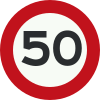 A1: maximum speed limit
 A2: end of maximum speed limit
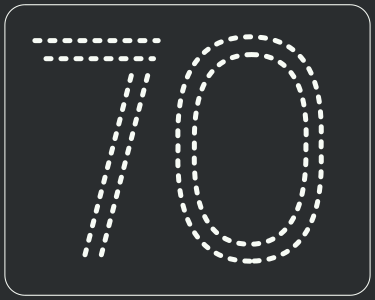 A3: maximum speed shown on an electronic signalling sign
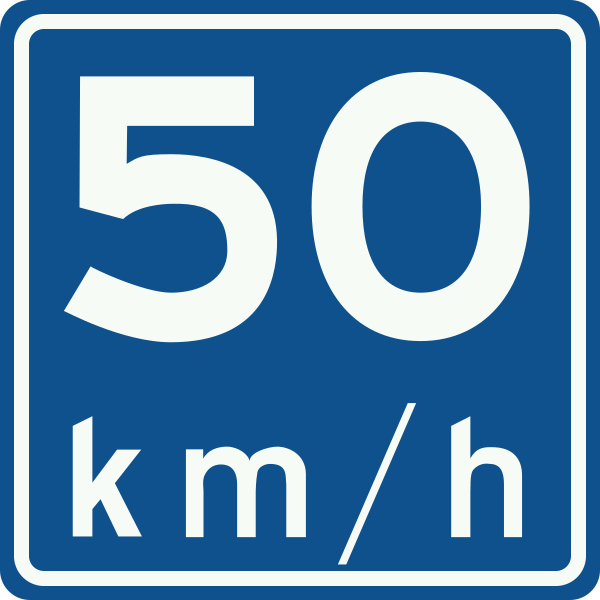 A4: advisory speed
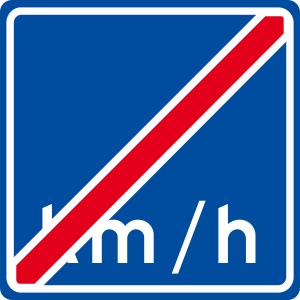 A5: end of recommended (advisory) speed
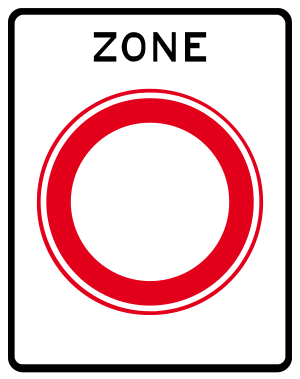 A1ZB: maximum speed zone (start)
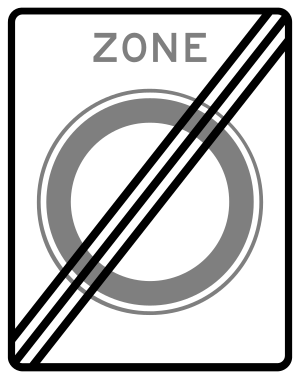 A2ZE: end of the maximum-speed zone
Practise this with 2,609 questions and 19 animations
Rijtheorie Hub practises exactly like the CBR exam: 50 questions, 30 minutes, pass with 44. Free to try, in 12 languages.
Download free