Rijtheorie HubPractise the CBR theory in 12 languagesFree on the App Store
Open
Home › Theory exam practice › Practise Environment and economical driving

Practise Environment and economical driving

8 free practice questions on environment and economical driving for the Dutch CBR car theory exam. Economical and clean driving, emissions, tyres and low-emission zones. After every answer you see the explanation and the source. The app has 147 questions on this topic.

What you need to know

From the theory guide: Environmental Zone, Zero-Emission Zone and Eco-Driving in Amsterdam
8 free questions on environment and economical driving

Score: 0 of 0
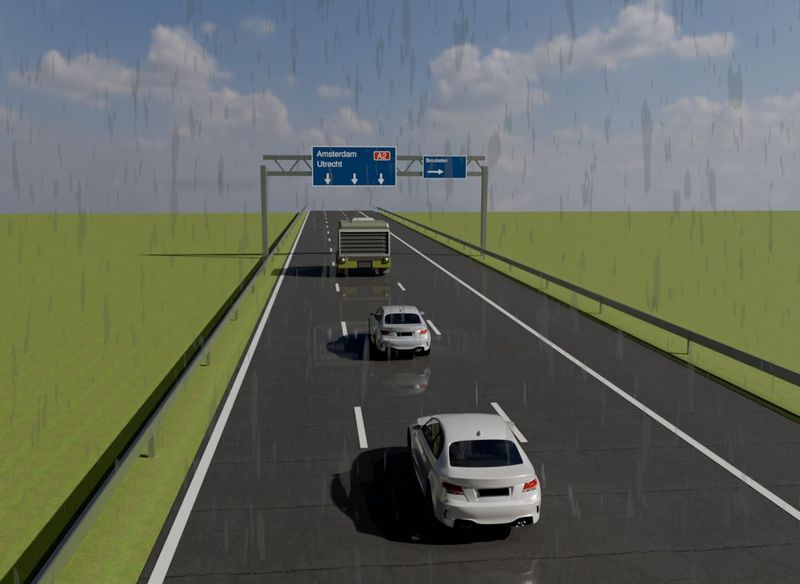
3D traffic situation for question 1

1. It is raining hard on the motorway. Just ahead of you is a passenger car and further ahead a truck. Is this a good moment to use cruise control?

Show in Dutch

Het regent hard op de autosnelweg. Vlak voor je rijdt een personenauto en verderop een vrachtauto. Is dit een goed moment om de cruisecontrol te gebruiken?

Explanation: No. Cruise control is meant for a quiet, dry road where you can keep the same speed for a long time. In rain and with traffic just ahead you have to adjust your speed yourself all the time to keep your distance and be able to stop in time (RVV art. 19); cruise control keeps the throttle on, even when the car loses grip through aquaplaning. Economy never comes before safety.NL: Nee Source: RVV 1990 art. 19; WVW 1994 art. 5; CBR theorie: het nieuwe rijden (cruisecontrol)

2. What is the main difference between a low-emission zone (sign C22a) and a zero-emission zone (sign C22c)?

Show in Dutch

Wat is het belangrijkste verschil tussen een milieuzone (bord C22a) en een nul-emissiezone (bord C22c)?

Explanation: The low-emission zone (sign C22a, RVV 1990 art. 86d) applies to passenger cars, vans, lorries and buses with a diesel engine; a supplementary sign states the admitted emission classes (for passenger cars, since 1 January 2025, at least emission class 4 or 5). The zero-emission zone (sign C22c, RVV 1990 art. 86e) has applied since 1 January 2025 to vans and lorries: only zero-emission vehicles may enter, with transitional periods for existing vans and lorries. Passenger cars are not covered by the zero-emission zone. Both zones exist side by side.NL: De milieuzone weert dieselvoertuigen met een te lage emissieklasse; de nul-emissiezone laat alleen emissieloze bedrijfs- en vrachtauto's toe. Source: RVV 1990 art. 86d en 86e; bijlage 1 borden C22a en C22c

3. On a cold morning you want to drive off economically and as cleanly as possible. What does 'Het Nieuwe Rijden' advise?

Show in Dutch

Op een koude ochtend wil je zuinig en zo schoon mogelijk wegrijden. Wat adviseert Het Nieuwe Rijden?

Explanation: Letting a cold engine warm up at idle wastes fuel and produces relatively high emissions, because the catalytic converter is still cold. The engine warms up fastest and cleanest by driving off gently right away.NL: Meteen rustig wegrijden; de motor niet stationair laten warmdraaien Source: RVV 1990

4. You drive a petrol car and want to accelerate as economically as possible according to 'Het Nieuwe Rijden' (eco-driving). At roughly what engine speed do you shift up to a higher gear?

Show in Dutch

Je rijdt een benzineauto en wilt volgens Het Nieuwe Rijden zo zuinig mogelijk optrekken. Bij welk toerental schakel je ongeveer op naar een hogere versnelling?

Explanation: For a petrol engine 'Het Nieuwe Rijden' advises shifting up at around 2,500 rpm; for a diesel already around 2,000 rpm. Shifting early and driving in a high gear at low revs saves fuel. Revving to 3,500 or higher wastes fuel.NL: Bij ongeveer 2.500 toeren per minuut Source: RVV 1990

5. You approach a red traffic light and want to save fuel by coasting. What is the most economical way?

Show in Dutch

Je nadert een rood verkeerslicht en wilt door uitrollen brandstof besparen. Wat is de zuinigste manier?

Explanation: As long as you stay in gear, the engine cuts off the fuel supply while coasting: consumption is then zero. In neutral or with the clutch pressed the engine idles and does use fuel. Switching the engine off while driving is dangerous: brake and steering assistance are lost and the steering lock can engage.NL: De auto in de versnelling laten uitrollen en pas bij lage snelheid terugschakelen Source: RVV 1990

6. According to 'Het Nieuwe Rijden', from what waiting time is it worthwhile to switch off the engine while stationary?

Show in Dutch

Bij welke wachttijd is het volgens Het Nieuwe Rijden zinvol om bij stilstand de motor uit te zetten?

Explanation: The guideline is: if you are stationary for more than about a minute (for example at a level crossing, an open bridge or in a long traffic jam), switch the engine off. Many cars do this automatically with start-stop. The idea that restarting uses a lot of fuel is outdated.NL: Bij stilstand langer dan ongeveer 1 minuut Source: RVV 1990

7. Your tyres have been about 0.5 bar too low for months. What is the main consequence?

Show in Dutch

Je banden staan al maanden ongeveer 0,5 bar te zacht. Wat is hiervan het belangrijkste gevolg?

Explanation: Under-inflated tyres increase rolling resistance: you use more fuel and the tyres wear faster on their outer edges. The tyre also heats up, the blow-out risk rises and handling worsens. Wear in the middle is a sign of over-inflation instead.NL: Meer rolweerstand, dus hoger brandstofverbruik, plus snellere slijtage aan de buitenranden van het loopvlak Source: RVV 1990

8. From 1 January 2025, several cities have zero-emission zones. Do these zones also immediately apply to ordinary petrol and diesel passenger cars?

Show in Dutch

Vanaf 1 januari 2025 gelden in verschillende steden zero-emissiezones. Gelden deze zones ook meteen voor gewone benzine- en dieselpersonenauto's?

Explanation: The zero-emission zones from 1 January 2025 apply to vans and trucks; ordinary passenger cars are (not yet) covered by them.NL: Nee, de zones gelden voor bestelauto's en vrachtwagens, niet voor gewone personenauto's Source: Zero-emissiezones (bestelauto's en vrachtwagens, vanaf 1-1-2025)

Memory hooks for this topic

With 'Het Nieuwe Rijden' (eco-driving) you shift up early: around 2000-2500 rpm in a petrol car, around 2000 rpm in a diesel. A high gear at low revs uses less fuel.

Picture a lazy cat that yawns at 2000 rpm: the moment the needle reaches there, it lazily clicks up a gear. Low revs = low fuel.

Look far ahead and anticipate the traffic. Reacting in good time means less hard braking and accelerating, which saves fuel and wear and is safer.

Drive as if binoculars are strapped to your nose: the farther you look, the softer your feet become on the gas and brake.

Let the car coast to slow down: lift your foot off the accelerator while staying in gear. The fuel supply is cut off completely, so you burn zero fuel.

Foot off the gas but still in gear = the fuel tap shuts. Coasting in neutral (clutch down) leaves the tap running.

Check tyre pressure regularly, at least once a month. Too low pressure raises rolling resistance, so you use more fuel, tyres wear faster and the car handles less safely.

Think of the first of the month as 'tyre day': soft tyres are like running on sand, costing extra effort and thus extra fuel.

All memory hooks for this topic

Read and practise more

Other topics

Practise Right of way

Who goes first: at uncontrolled junctions, at give-way lines and stop signs, on roundabouts and with trams, buses and emergency vehicles.

10 free questions here · 376 in the app

Practise Traffic rules

Speeds, overtaking, lanes, lights, parking and stopping: the rules you need everywhere.

10 free questions here · 297 in the app

Practise Hazard perception

You see a traffic situation and choose what you do: brake, release the accelerator or do nothing.

21 free questions here · 219 in the app

Practise Special manoeuvres

Reversing, turning round, pulling away, merging, parking and towing.

10 free questions here · 204 in the app

Practise Vulnerable road users

Pedestrians, cyclists and moped riders, children, older people and blind or partially sighted pedestrians.

8 free questions here · 191 in the app

Practise Special conditions

Driving in rain, fog, slippery conditions, strong wind, low sun and in the dark.

9 free questions here · 196 in the app

Practise Vehicle knowledge

Dashboard warning lights, tyres, the APK (MOT), insurance and your documents.

10 free questions here · 143 in the app

Practise Traffic insight

Looking ahead, keeping your distance, knowing your stopping distance and predicting what others will do.

10 free questions here · 189 in the app

Practise Motorway and autoweg

Merging and exiting, keeping right, overtaking, peak-hour lanes, matrix signs and breaking down.

10 free questions here · 157 in the app

Practise Alcohol and fitness to drive

Alcohol, drugs, medicines, tiredness, emotions and being able to see well.

10 free questions here · 138 in the app

Practise road signs

Recognising signs and road markings and knowing what they ask of you.

Quiz with all signs · 352 sign questions in the app

Practise this with 2,609 questions and 19 animations

Rijtheorie Hub practises exactly like the CBR exam: 50 questions, 30 minutes, pass with 44. Free to try, in 12 languages.

Download free